




Prefer a conversation?
Our team is always available to guide you through the process and ensure your experience is perfectly matched to your preferences.
Our team is always available to guide you through the process and ensure your experience is perfectly matched to your preferences.
Duration
10 Nights
Price
From $10,550
Ship
Silver Wind Expedition
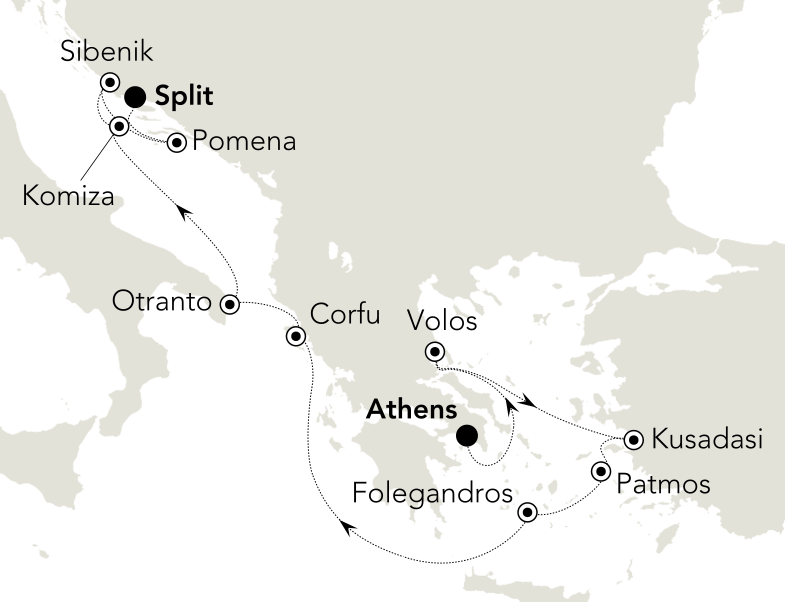
A 10-night expedition voyage aboard Silver Wind, Athens, Greece to Split, Croatia. Destination: Mediterranean.
Operated by Silversea Cruises aboard Silver Wind Expedition.
Athens (Piraeus)
Volos
Kusadasi
Patmos
Folegandros
Otranto
Komiza
Sibenik
Pomena
Split
A city of legend, civilisation and enduring culture, Athens is a majestic and magical urban sprawl. Extraordinary elegance and grace combine with grit and graft in Greece's capital, where highways encase ruins from antiquity, and gleaming museums and galleries stand beside concrete sprayed with edgy street art. These contrasts enhance and elevate the wonders of this 2,500-year-old city, however, which can count notable contributions to philosophy, drama and democracy, among its global legacy. Piraeus' giant port and naval base welcome you to the edge of the Athens' urban area. From there it's a simple jaunt to the centre. The majestic ancient citadel of the Acropolis dominates an elevated platform and is a constant presence as you explore the city. The wonderful remains of the columned temple of the Parthenon - which date back to the 5th century BC - stand here, representing the pinnacle of classical architecture. The nearby Acropolis Museum adds context to your visit and frames the broad views from its giant glass windows. Or rise up Mount Lycabettus, to be rewarded with perhaps Athens' best panorama of the Acropolis sitting high over the city on its grand stage. See the marble horseshoe of the Old Olympic Stadium, where the first modern Olympics were held in 1896, for more of the city's enduring legacy. Elsewhere, golden beaches and temples stretch out along the coastline, should you wish to explore a little further afield. Coffee is an art form to the Greeks, and it's an unwritten rule that coffee time must never be rushed. So prepare to settle down for a couple of hours and lose yourself in a good chat. Feeling hungry - try traditional souvlaki made with sauces handed from generation to generation.
Nestled ideally between the gentle lapping waves of the Pagasetic Gulf and Mount Pelion, Volos is a Greek seaside town worth visiting. The town enjoys a near mythic status as being home of Jason and his Argonauts, and that, along with its reputation for being ‘Land of the Centaurs’ should go some way to illustrating the degree of ancient history to be found in Volos. The city was severely damaged in an earthquake in 1955 which regrettably means that much of the 19th-century architecture has been lost or damaged. A few traces do remain however, fine examples of neo-classical architecture that are hidden away around the town. If you want your history a little older than that, the superb archaeology museum will both surprise and delight you. Not only will you find objects from the Ancient Greek era but recent excavations have unearthed artefacts from the first Neolithic settlements of Dimini and Sesklo. The city itself is flat and easy to negotiate on foot. Or better still, make like the locals and hire a bike to cycle the city. For those feeling a little more adventurous, the 8-mile cycle up Mont Pelion rewards the sporty cycler with traditional stone tavernas and breathtaking views of the region. If relaxing closer to home is more your glass of ouzo, make for Palia, the old part of Volos, famous for having some of the finest cuisine on the mainland. Head into the narrow alleys, order a tsipouradika (a combination of traditional spirit served with local mezze) and enjoy.
Explore the towering columns, and storied remains of Ephesus - one of the most spectacular cities left by the Ancient Greeks. Kusadasi welcomes you to the Turkish coastline and is your base for exploring these majestic remains, which sit just 10 miles inland from the port. The Ephesus UNESCO World Heritage Site is a true archaeological gold mine, and an amazingly well-preserved site - once home to 150,000 people. The grand Temple of Artemis rose up majestically here and was recognised as one of the Seven Wonders of the Ancient World before its untimely destruction. The grand city was a fitting location for such a wonder, and with a mere 20% estimated to have been uncovered, the scale and majesty of Ephesus is hard to fully comprehend, as you walk its ancient streets. Visit the precious Library of Celsus - a gorgeous, double-layered façade of columns and artistry - and enjoy the city's gently illuminated, atmospheric venues - which still host stirring evening concerts. Ephesus's museum adds context to the 25,000 treasures that are exhibited within. After a long hot day exploring, recharge with a perfectly-charred and seasoned kebab or vegetable and rice stuffed grape leaves like dolma. In Kusadasi itself, you can discover a lively seaside city with a buzzing Aegean beach scene, and a glut of restaurants and cafes to kick back in.
The seahorse-shaped Patmos is a Greek island of stunning seascapes and immense cultural significance.Whether you’re religious or not there is something of the divine in this gorgeous island - a place of sanctuary fringed by crystal-clear waters and blissful beaches. Sleepy whitewash towns gleam in the strong sunshine while cats slink between the crumbling walls of this ruggedly beautiful island. High on the hillside above the cobalt-blue bay you’ll find the sacred chapel where an exiled John of Patmos is said to have entered the Cave of the Apocalypse and prophesied of the end of the world’s fire and brimstone – a striking juxtaposition with the peaceful serenity of the calm location. Higher up you’ll find the 11th-century Monastery of St. John which offers spectacular views of the island’s mounds curving around like a scorpion’s tail. It stands watching over the island like a fortified crown. Sun-wrinkled black-robed monks climb the streets up to this World Heritage site where bells peel out melodically. Inside vaulted chambers and stunning frescoes tell stories amid the striking religious iconography. Chora’s incredible narrow streets - moulded white - are an enchanting place to lose your bearings spreading below the monastery. Elsewhere blissful beaches stretch out across the coastline or this remote Greek island’s curves can be admired while bobbing offshore in a sailboat.
There is popular saying that good things come in small packages, or that small is beautiful. And never has a truer word been said when talking about Folegandros. Because this little island in the Aegean packs a big punch. What it might lack in mainstream tourism – you won’t see any all-day breakfasts or Sky sports channels here – is more amply made up by the mouthwatering cuisine, stunning beaches, azure Aegean waters and secluded coves. At just 12.5 m2 this tiny Cycladic gem – along with its 765 year round inhabitants – is a pearl waiting to be polished. Named after the son of King Minos the island’s auspicious history is eclipsed by its beauty. Used as a prison for exiled political prisoners until last century the island’s remote location is a happy blessing for those who want step back in time. Despite being so secluded there is plenty for visitpors to do once they have arrived in the charming harbour and its village. The pebbly beaches are covered with tamarisk trees while scenic Karavostássis with its beautiful beach is the perfect starting point for an exploration of the five other glorious beaches of on the island. Livádi a village with a sandy beach and turquoise waters is a must-see for all those who want to go off the beaten path but still want to swim in the warm Aegean waters. A boat tour of the island offers day-trippers to fully appreciate the tall cliffs and large “golden” cave (unfortunately closed to the public due to the archaeological excavations taking place). The whitewashed houses and zigzagging path are certainly worth the view from the water! A walk up the same path from the pretty village to the Church of the Assumption of the Virgin Mary takes about 15 minutes and offers stupendous views once you’re at the top.
Days at sea are the perfect opportunity to relax unwind and catch up with what you’ve been meaning to do. So whether that is going to the gym, visiting the spa, whale watching, catching up on your reading or simply topping up your tan these blue sea days are the perfect balance to busy days spent exploring shore side.
With its stern, steep fortifications, Otranto is an imposing, elevated and alluring port call. Learn a little of the history here, and you'll soon realise that this is a town that's right to be wary, having been conquered by - and repelled - many hostile visitors over its turbulent past. Visit Otranto to enjoy the heel of Italy's generous weather, bright white beaches, and the tug-of-war history between east and west. The turquoise seawater offers an enticing welcome, but this is a town haunted by past events. The darkest chapter occurred in 1480, when 813 were slaughtered after refusing to convert when Ottoman invaders conquered the city - following a fierce 15 days of resistance. The bones and skulls of the Martyrs of Otranto now watch over the altar of the cathedral, where they are stacked up behind a wall of glass. They were canonised by Pope Francis In 2012, and are recognised as Otranto's patron saints. Less macabre, the cathedral’s wonderful rose window and mosaic floor are gloriously beautiful, dating back to the 12th century. Head to the beach to soak up some sun and views of the sparkling Adriatic in Italy's most easterly town, or wander the pretty, cafe-lined streets of the historic old town amid the stout round towers of the extraordinary ramparts. Enjoy the leisurely pace of life along these tight, history-steeped alleyways, and try some of Puglia's delicious food, like the deceptively simple pasta cacio e pepe – pasta with cheese and pepper, or fresh hauls of prawns. Hidden beaches, gaping caves, and scattered fortifications litter the surrounding coastline.
Set on the dazzling Adriatic where the Krka River opens out into the blue island-peppered waters Šibenik is a stone-clad city that oozes Dalmatian medieval charm. Gorgeous Krka National Park gushes with famously picturesque waterfalls close by while the World Heritage Sites of Croatia’s oldest native town have endless stories to tell. Rising from the shadow of popular neighbours Split and Zadar Šibenik is successfully establishing itself as an unmissable Dalmatian city thanks to its timeless grace and 30 hidden churches and monasteries - which ring their bells above a wash of terracotta roofs. Dominating the tight streets of the charming old town - where ice cream vendors spoon out fruity flavours and footsteps rattle along stone streets - is the magnificent Cathedral St. James UNESCO World Heritage site. Taking more than a century to construct it is built from stone in a Gothic-Renaissance style and adorned with 71 sculptured heads - each displaying its own personality. St. Michael’s Fortress stands on a hill above the city providing the perfect viewpoint to see Šibenik rolling towards the stunning archipelago which punctuates the turquoise Adriatic. Part of the fortress is now used as an open-air stage forming an ethereal venue for performances. St. Nicholas Fortress is another UNESCO protected site and was built where the monastery of St. Nicholas once stood. Further afield the beautiful old town of Trogir is close by along with the Roman ruins of Salona.
Bathing in the Dalmatian Coast’s generous sunshine and overlooking sparkling island-studded waters Split is a city of romantic beauty built around an extraordinary - still beating - historical heart. The setting may be spectacular but it’s the Diocletian’s Palace - a Roman remain of incredible scale and detail that is truly bewitching. With a natural backdrop of dramatic limestone mountains and Croatia’s trademark scenic wonders all around Split is a true heavyweight of the Adriatic. To enter Split’s Diocletian’s Palace is to step into a beautiful time warp. Head first to the Cathedral of Saint Domnius where a hollow bell tower rockets up puncturing the sky. The perfume of lavender hangs heavy wherever you walk in the old town where tucked shops offer artisan chocolates dried figs and freshly-ground coffees. The expansive seafront promenade is all palm trees buzzing bars and eateries and further out you’ll find the peace of Marion Hill - where you can climb to some of the best views in town. Or take the far less exerting wander to Sustipan cemetery’s breathtaking panorama of sea city and distant islands. Trips to island paradises like Hvar and Brac are tempting as are longer excursions to sites like Krka National Park’s Waterfalls - where wide terraces of frothing water thunder into cooling swimmable splash pools below. Nearby Trogir is another UNESCO World Heritage Site offering a cosier no less charming old town and historic port.
From $10,550
per guest · 10 nights
Prices are a guide and vary with season, cabin category and party size. Your advisor will confirm the exact cost before anything is booked.
Classic Veranda
suite
Deluxe Veranda
suite
Grand 1 Bedroom
suite
Grand 2 Bedroom
suite
Medallion
suite
Owner 1 Bedroom
suite
Owner 2 Bedroom
suite
Royal 1 Bedroom
suite
Royal 2 Bedroom
suite
Silver
suite
Vista
suite








