




Prefer a conversation?
Our team is always available to guide you through the process and ensure your experience is perfectly matched to your preferences.
Our team is always available to guide you through the process and ensure your experience is perfectly matched to your preferences.
Duration
11 Nights
Price
From $9,050
Ship
Silver Dawn
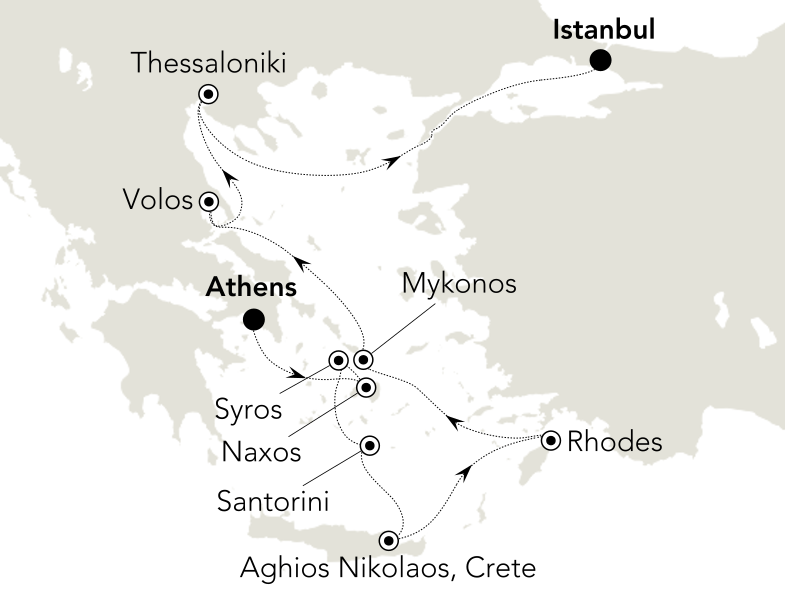
A 11-night ocean voyage aboard Silver Dawn, Athens, Greece to Istanbul, Turkey. Destination: Mediterranean.
Operated by Silversea Cruises aboard Silver Dawn.
Athens (Piraeus)
Naxos
Syros
Santorini
Aghios Nikolaos, Crete
Rhodes
Mykonos
Volos
Thessaloniki
Istanbul
A city of legend, civilisation and enduring culture, Athens is a majestic and magical urban sprawl. Extraordinary elegance and grace combine with grit and graft in Greece's capital, where highways encase ruins from antiquity, and gleaming museums and galleries stand beside concrete sprayed with edgy street art. These contrasts enhance and elevate the wonders of this 2,500-year-old city, however, which can count notable contributions to philosophy, drama and democracy, among its global legacy. Piraeus' giant port and naval base welcome you to the edge of the Athens' urban area. From there it's a simple jaunt to the centre. The majestic ancient citadel of the Acropolis dominates an elevated platform and is a constant presence as you explore the city. The wonderful remains of the columned temple of the Parthenon - which date back to the 5th century BC - stand here, representing the pinnacle of classical architecture. The nearby Acropolis Museum adds context to your visit and frames the broad views from its giant glass windows. Or rise up Mount Lycabettus, to be rewarded with perhaps Athens' best panorama of the Acropolis sitting high over the city on its grand stage. See the marble horseshoe of the Old Olympic Stadium, where the first modern Olympics were held in 1896, for more of the city's enduring legacy. Elsewhere, golden beaches and temples stretch out along the coastline, should you wish to explore a little further afield. Coffee is an art form to the Greeks, and it's an unwritten rule that coffee time must never be rushed. So prepare to settle down for a couple of hours and lose yourself in a good chat. Feeling hungry - try traditional souvlaki made with sauces handed from generation to generation.
A little bit more rough and ready around the edges than a lot of other Greek islands, Naxos is the thinking-person’s Greece. The largest of all the Cyclades islands, it was once the cultural centre of Classical Greece and Byzantium, so do not be surprised that the world’s oldest culture has left its mark. Museums range from the Archaeological Museum (housed in an elegant Venetian mansion), an impressive geological museum to the lovely Venetian and unusual museum, housed in an 800-year old private house. For those who want to venture further afield, Haki, the old capital of Naxos, has a great distillery museum, run by the same family who first opened it in 1896. Not only are there two lovely monasteries worth visiting, but because of its high mountains Naxos benefits from much more rainfall than most other Greek islands, which makes the land very green and fertile. Local produces includes olives, grapes, figs, citrus fruit, corn and potatoes and if you get a chance, a healthy home-grown meal in a back-country taverna will be undoubtedly be memorable. The golden sands that circle Naxos are particularly nice, catering for all personality types. The active among you will certainly want to head to the eastern side of the island, where the wind is perfect for budding kite and windsurfers, as well as those who like their beaches as natural as can be. The western side of the island, notably Platka beach, is where the sun-lovers will be seen soaking up the rays.
Beautiful sea crisp white beaches and charming medieval villages add character and colour to this gorgeous Greek Island. Part of the Cyclades group of islands visit the capital Ermoupoli to discover a network of picturesque narrow streets and winding alleyways - dotted with fancy old Venetian mansions and elegant domed churches. The colourful town cascades down to an open waterfront of pine-trees and beautiful views. Head to the sparkling marbled central square overlooked by the Town Hall and surrounded by a celebrated collection of neoclassical buildings facing up across narrow streets. A town of peeking bell towers and cobalt-blue domed churches - stop by the Church of the Assumption which treasures an original El Greco wonder inside. Further up you'll find the small monastery-sprinkled medieval village of Ano Syros. Settled on a hill it offers a glorious view down over the port and white dwellings of Ermoupoli below. You can visit Capuchin Monastery which was built in the 16th century to help the underprivileged. Encounter the Vamvakaris Museum dedicated to Markos Vamvakaris a famous rebetiko musician born here in 1905. Of course Syros is also surrounded by plenty of blissful beaches if you'd rather hit the sands. Finikas beach is nearby and a long luxurious stretch complete with sunbeds and umbrellas. Perfect for catching some sun and shade and watching the blue seawater twinkling.
Breathlessly romantic, and incredibly scenic, the azure domes and whitewash buildings that cascade down Santorini's slopes are prime honeymoon material - and relentlessly romantic. A true gem of the Cycladic island group, Santorini is startlingly pretty, and its white windmills and dazzling villages are incredibly easy on the eye. Envy-inducing and evocatively beautiful, Santorini's sunsets are legendary, and the island is a highlight of any voyage to the Greek islands. Look out over the endless expanse of blue waves, filling the massive volcanic caldera of Santorini – and absorb one of the most spectacular views in the world. The sheer rock shoulders of the caldera create an immense, natural amphitheatre - so enjoy the show, as you sip a local, volcanic-mineral enhanced white wine, and fall in love all over again. Any meal is well rounded off with the famous wine, Vinsanto. The east side of the island may lack the incredible panoramas, but it's ideal if all you want to do is recline on volcanic-sand beaches - which range in hues from charcoal-black to flame-red. This beautiful island was forged by powerful volcanic activity, and you can learn more about the huge eruption of 1,600 BCE - which wiped out the Minoan city at Akrotiri. The eruption sank the centre of the island, forming the moon-shaped topography we see now. Visit the archaeological site that has revealed and preserved the village, which was lost to time below the pumice and ash. Some whisper that this destroyed town may even be the fabled Atlantis.
Set on the east of the Greek island Crete Aghios Nikolaos is a place of legend and luxury. Pastel-coloured houses jostle attractively around the pretty harbour and inky lake while busy restaurants and cafes spill out onto its lively waterfront. Life here orbits around Lake Voulismeni and the legendary lake is said to be bottomless and to have been a bathing spot for Greek goddesses Athena and Artemis. Enjoy heavenly views of the water through frames of pretty violet flowers or climb the stone steps for a sweeping panorama of the town lake and seas beyond. With abundant waterfront hours meander past effortlessly in the town’s humming cafes as characters come and go and sunlight flicks off the sparkling waves. Aghios Nikolaos is surrounded by wide scenic beaches and you can choose between Voulisma - where crystal-clear water lolls against fine sand or Almyros – where a refreshing ribbon of cooling freshwater snakes out into warm turquoise seawater. Away from the beaches look for the brightly-frescoed Panagias Keras Church - one of the region’s oldest Byzantine churches - which dates back to the 13th century. Explore local farms to taste fresh oil crushed from plump olives ripened by the generous Cretan sun.
Colossus of Rhodes: a colossal question mark The sixth of the Seven Wonders of the Ancient World, the Colossus of Rhodes has only been standing for a very short time. Although world-renowned, this gigantic statue is a mystery. If nothing remains of the Colossus today, its origins are documented in historical writings about the siege of Rhodes from 305-304 BC. To force the Rhodians not to support Egypt, Macedonia sent his troops to lay siege to Rhodes. Despite the construction of a 30-metre-high siege tower protected by metal plates and equipped with catapults, Rhodes held the siege for more than a year before Macedonia withdrew. To celebrate their victory and thank the gods for allowing them to resist, the inhabitants of Rhodes decided to build an extraordinary statue in honour of Helios, the Sun and protector of the island. According to the writings, it required between 12 and 13 tonnes of bronze. Some of this was salvaged from the siege tower and the rest was financed by the sale of weapons and armour abandoned by the Macedonians. The construction of the Colossus was entrusted to Charés de Lindos, a sculptor from Rhodes. It took him 12 years to complete. Sixty-five years later, in 225 or 226 BC, after having won the admiration of the world for its appearance and the technique used to build it, an earthquake caused the statue to twist at the knees and to topple to the ground its 33 metres (108ft). Although Ptolemy III of Egypt offered to finance its reconstruction, the Rhodians refused, an oracle having forbidden them to touch the remains of the Colossus. The tonnes of bronze on the ground allowed people to continue to marvel at the statue until 654, when the Umayyad Muslims dismantled his remains, whose "fingers were bigger than most statues", according to Pliny. It would have taken more than 900 camels to carry away all of its remains. Everything else is guesswork. Despite all the wonder that the statue aroused, no records of its appearance or location have come down to us. However, scientists believe that the figure depicted in the popular image with his legs spread out over the entrance to the port of Rhodes is pure invention. Technically, the structure could not have survived. It is more than likely that this marvel of engineering, almost as tall as the Statue of Liberty, had its legs squeezed together. Its location, too, remains a mystery to this day.
Days at sea are the perfect opportunity to relax unwind and catch up with what you’ve been meaning to do. So whether that is going to the gym, visiting the spa, whale watching, catching up on your reading or simply topping up your tan these blue sea days are the perfect balance to busy days spent exploring shore side.
Indulge in idyllic island life, as you take your fill of superb foods and wines, and soak in endless views of sweeping turquoise seascapes and pretty whitewash buildings. Known for its lively nightlife and rejuvenating, care-free outlook, Mykonos is a dazzlingly beautiful island escape. The secret is well and truly out, but nonetheless, Mykonos has managed to retain the enduring, exclusive allure that first drew celebrities like Brigitte Bardot to its star-studded shores. True to its roots, Mykonos is a rich land of culture, tradition and swirling legend, and the island is said to be built on the frozen bodies of giants slain by Hercules and to have been the legendary battleground between Zeus and the Titans. Head out onto the crystalline waters to seek out serene islands, hit perfect beaches, or venture into the labyrinth of Mykonos Town. White facades, red roofs and cobalt blue shutters add to this lively town’s appeal. Explore narrow streets housing studios – where artisans piece together mosaics - and plenty of restaurants and bars offer sanctuary. Head to Little Venice for a waterfront view of one of the island’s famed sunsets, and to enjoy an aperitif of the favourite aniseed liqueur, ouzo. Boasting numerous attractive sandy coves, a wealth of top-notch restaurants, and rich cultural appeal, it’s little wonder that Mykonos is one of the most popular Greek Islands. Discover this jaw-droppingly scenic island paradise, watched over by its iconic huddles of picturesque windmills.
Nestled ideally between the gentle lapping waves of the Pagasetic Gulf and Mount Pelion, Volos is a Greek seaside town worth visiting. The town enjoys a near mythic status as being home of Jason and his Argonauts, and that, along with its reputation for being ‘Land of the Centaurs’ should go some way to illustrating the degree of ancient history to be found in Volos. The city was severely damaged in an earthquake in 1955 which regrettably means that much of the 19th-century architecture has been lost or damaged. A few traces do remain however, fine examples of neo-classical architecture that are hidden away around the town. If you want your history a little older than that, the superb archaeology museum will both surprise and delight you. Not only will you find objects from the Ancient Greek era but recent excavations have unearthed artefacts from the first Neolithic settlements of Dimini and Sesklo. The city itself is flat and easy to negotiate on foot. Or better still, make like the locals and hire a bike to cycle the city. For those feeling a little more adventurous, the 8-mile cycle up Mont Pelion rewards the sporty cycler with traditional stone tavernas and breathtaking views of the region. If relaxing closer to home is more your glass of ouzo, make for Palia, the old part of Volos, famous for having some of the finest cuisine on the mainland. Head into the narrow alleys, order a tsipouradika (a combination of traditional spirit served with local mezze) and enjoy.
Thessaloniki: the former Jerusalem of the Balkans Founded in the 4th century BC by a friend of Alexander the Great, the city replaced Pella, whose access channel from the sea had become blocked over time. Four and a half centuries later, in 50 AD, Thessaloniki became the very first place of preaching in Christianity when the Apostle Paul came to convert the Greek pagans. Three centuries later, it was still in Thessalonica that the three Emperors reigning over the Roman Empire in 380 signed the Edict of Thessalonica, making the Christian religion the official - and only - religion of the Roman Empire. However, a few centuries later, when the city came under Ottoman rule, it was not the Christians, or even the Muslims, who were in the majority. In fact, from the 16th century until the beginning of the 20th century, it was the Jewish community that made up the bulk of the city's inhabitants - up to 70,000 at the beginning of the 20th century - earning it the nicknames Mother of Jerusalem or Jerusalem of the Balkans. The city's Jewish cemetery, razed in 1942 and since replaced by the Aristotle University of Thessaloniki, housed an estimated 500,000 graves, making it the largest Jewish cemetery in Europe and probably the world. It is thanks to one of the members of this community that one of the city's emblems owes its name: the White Tower. Built in the fifteenth century by the Ottomans to replace an earlier Byzantine fortification, it was long used as a prison, torture and execution chamber, earning it the name of the Blood Tower. A name that the authorities of the time wanted to 'whitewash'. A Jewish convict, Nathan Guiledi, was offered the chance to do it in exchange for his freedom. Although the tower is no longer white, it has kept its name and now houses a museum on the history of the city.
Days at sea are the perfect opportunity to relax unwind and catch up with what you’ve been meaning to do. So whether that is going to the gym, visiting the spa, whale watching, catching up on your reading or simply topping up your tan these blue sea days are the perfect balance to busy days spent exploring shore side.
A chaotic, colossal collision of east and west – start your day in Europe and end it in Asia, all without breaking a sweat. Sprawling across two continents, the city has been toed, froed and yanked between countless civilisations over its history, leaving a multi-layered, majestic tapestry of culture to untangle. An army of narrow minarets puncture the skyline, while the soaring towers of palaces and labyrinths of bazaars - where bargains are the reward for brave hagglers - fill up this dynamic city of 15 million people. With a rich portfolio of Byzantine and Ottoman architecture, Istanbul enjoys one of the world's most dynamic skylines and has an intense, infectious energy. The vast Aya Sofya is the starting point for exploring this huge city's deep wealth of cultural treasures. Built in the 6th century as a Greek Orthodox church, it was later transformed into an Ottoman imperial mosque – and latterly a museum. Cast your eyes up to take in the full scale of the colossal dome, one of the world's largest, which floats on a magnificent bed of light. See the Blue Mosque, with its glorious blue İznik tiles, or head to the Galata Tower which was once the tallest structure in Istanbul, and is ideal for a panoramic view of the city. Grab handfuls of dates and spices, shop for jewellery and patterned fabrics as you're swallowed whole by the Grand Bazaar - one of the world's biggest and busiest covered indoor markets. To understand Istanbul is to visit its kahvehans. Few rituals are taken as seriously as Turkish coffee - prepared to be incredibly strong. Sweeten the aftertaste with Turkish delight, or baklava – try the smooth pistachio version called kuru baklava.
From $9,050
per guest · 11 nights
Prices are a guide and vary with season, cabin category and party size. Your advisor will confirm the exact cost before anything is booked.
Classic Veranda
suite
Deluxe Veranda
suite
Grand 1 Bedroom
suite
Grand 2 Bedroom
suite
Owner 1 Bedroom
suite
Owner 2 Bedroom
suite
Panorama
suite
Royal 1 Bedroom
suite
Royal 2 Bedroom
suite
Silver
suite
Silver 2 Bedroom
suite
Superior Veranda
suite
Vista
suite








