




Prefer a conversation?
Our team is always available to guide you through the process and ensure your experience is perfectly matched to your preferences.
Our team is always available to guide you through the process and ensure your experience is perfectly matched to your preferences.
Duration
12 Nights
Price
From $9,900
Ship
Silver Dawn
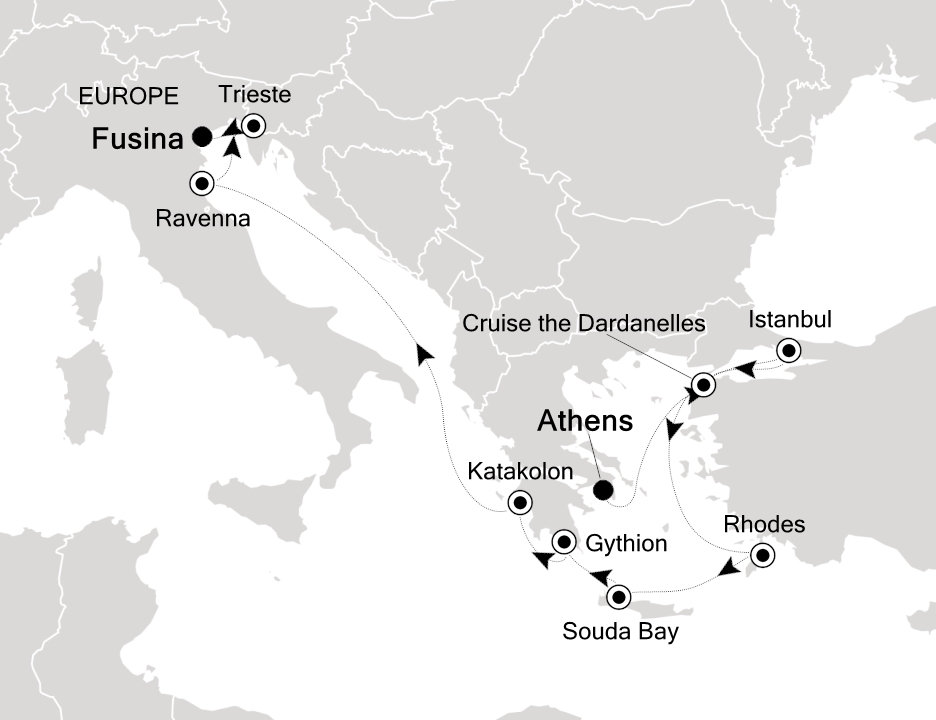
A 12-night ocean voyage aboard Silver Dawn, Athens, Greece to Fusina, Italy. Destination: Mediterranean.
Operated by Silversea Cruises aboard Silver Dawn.
Athens (Piraeus)
Santorini
Istanbul
Cruise the Dardanelles
Heraklion
Gythion
Katakolon (Olympia)
Ravenna
Trieste
Fusina (Venice)
A city of legend, civilisation and enduring culture, Athens is a majestic and magical urban sprawl. Extraordinary elegance and grace combine with grit and graft in Greece's capital, where highways encase ruins from antiquity, and gleaming museums and galleries stand beside concrete sprayed with edgy street art. These contrasts enhance and elevate the wonders of this 2,500-year-old city, however, which can count notable contributions to philosophy, drama and democracy, among its global legacy. Piraeus' giant port and naval base welcome you to the edge of the Athens' urban area. From there it's a simple jaunt to the centre. The majestic ancient citadel of the Acropolis dominates an elevated platform and is a constant presence as you explore the city. The wonderful remains of the columned temple of the Parthenon - which date back to the 5th century BC - stand here, representing the pinnacle of classical architecture. The nearby Acropolis Museum adds context to your visit and frames the broad views from its giant glass windows. Or rise up Mount Lycabettus, to be rewarded with perhaps Athens' best panorama of the Acropolis sitting high over the city on its grand stage. See the marble horseshoe of the Old Olympic Stadium, where the first modern Olympics were held in 1896, for more of the city's enduring legacy. Elsewhere, golden beaches and temples stretch out along the coastline, should you wish to explore a little further afield. Coffee is an art form to the Greeks, and it's an unwritten rule that coffee time must never be rushed. So prepare to settle down for a couple of hours and lose yourself in a good chat. Feeling hungry - try traditional souvlaki made with sauces handed from generation to generation.
Breathlessly romantic, and incredibly scenic, the azure domes and whitewash buildings that cascade down Santorini's slopes are prime honeymoon material - and relentlessly romantic. A true gem of the Cycladic island group, Santorini is startlingly pretty, and its white windmills and dazzling villages are incredibly easy on the eye. Envy-inducing and evocatively beautiful, Santorini's sunsets are legendary, and the island is a highlight of any voyage to the Greek islands. Look out over the endless expanse of blue waves, filling the massive volcanic caldera of Santorini – and absorb one of the most spectacular views in the world. The sheer rock shoulders of the caldera create an immense, natural amphitheatre - so enjoy the show, as you sip a local, volcanic-mineral enhanced white wine, and fall in love all over again. Any meal is well rounded off with the famous wine, Vinsanto. The east side of the island may lack the incredible panoramas, but it's ideal if all you want to do is recline on volcanic-sand beaches - which range in hues from charcoal-black to flame-red. This beautiful island was forged by powerful volcanic activity, and you can learn more about the huge eruption of 1,600 BCE - which wiped out the Minoan city at Akrotiri. The eruption sank the centre of the island, forming the moon-shaped topography we see now. Visit the archaeological site that has revealed and preserved the village, which was lost to time below the pumice and ash. Some whisper that this destroyed town may even be the fabled Atlantis.
Days at sea are the perfect opportunity to relax unwind and catch up with what you’ve been meaning to do. So whether that is going to the gym, visiting the spa, whale watching, catching up on your reading or simply topping up your tan these blue sea days are the perfect balance to busy days spent exploring shore side.
A chaotic, colossal collision of east and west – start your day in Europe and end it in Asia, all without breaking a sweat. Sprawling across two continents, the city has been toed, froed and yanked between countless civilisations over its history, leaving a multi-layered, majestic tapestry of culture to untangle. An army of narrow minarets puncture the skyline, while the soaring towers of palaces and labyrinths of bazaars - where bargains are the reward for brave hagglers - fill up this dynamic city of 15 million people. With a rich portfolio of Byzantine and Ottoman architecture, Istanbul enjoys one of the world's most dynamic skylines and has an intense, infectious energy. The vast Aya Sofya is the starting point for exploring this huge city's deep wealth of cultural treasures. Built in the 6th century as a Greek Orthodox church, it was later transformed into an Ottoman imperial mosque – and latterly a museum. Cast your eyes up to take in the full scale of the colossal dome, one of the world's largest, which floats on a magnificent bed of light. See the Blue Mosque, with its glorious blue İznik tiles, or head to the Galata Tower which was once the tallest structure in Istanbul, and is ideal for a panoramic view of the city. Grab handfuls of dates and spices, shop for jewellery and patterned fabrics as you're swallowed whole by the Grand Bazaar - one of the world's biggest and busiest covered indoor markets. To understand Istanbul is to visit its kahvehans. Few rituals are taken as seriously as Turkish coffee - prepared to be incredibly strong. Sweeten the aftertaste with Turkish delight, or baklava – try the smooth pistachio version called kuru baklava.
A chaotic, colossal collision of east and west – start your day in Europe and end it in Asia, all without breaking a sweat. Sprawling across two continents, the city has been toed, froed and yanked between countless civilisations over its history, leaving a multi-layered, majestic tapestry of culture to untangle. An army of narrow minarets puncture the skyline, while the soaring towers of palaces and labyrinths of bazaars - where bargains are the reward for brave hagglers - fill up this dynamic city of 15 million people. With a rich portfolio of Byzantine and Ottoman architecture, Istanbul enjoys one of the world's most dynamic skylines and has an intense, infectious energy. The vast Aya Sofya is the starting point for exploring this huge city's deep wealth of cultural treasures. Built in the 6th century as a Greek Orthodox church, it was later transformed into an Ottoman imperial mosque – and latterly a museum. Cast your eyes up to take in the full scale of the colossal dome, one of the world's largest, which floats on a magnificent bed of light. See the Blue Mosque, with its glorious blue İznik tiles, or head to the Galata Tower which was once the tallest structure in Istanbul, and is ideal for a panoramic view of the city. Grab handfuls of dates and spices, shop for jewellery and patterned fabrics as you're swallowed whole by the Grand Bazaar - one of the world's biggest and busiest covered indoor markets. To understand Istanbul is to visit its kahvehans. Few rituals are taken as seriously as Turkish coffee - prepared to be incredibly strong. Sweeten the aftertaste with Turkish delight, or baklava – try the smooth pistachio version called kuru baklava.
The seaport of Canakkale Turkey, marks the entrance to the mythical Dardanelles Strait. This ancient, narrow passage of water has been the setting for stories through the ages, from Greek mythology to battle scenes of World War 1. Along with its counterpart the Bosporus, they make up the Turkish Straits, where east meets west. These strategic straits, separating Europe and Asia are of great cultural importance and there’s no better viewpoint to understand its considerable history than from the sea itself. Sailing the strait, the sheer beauty of the hilly landscape and lowland fields with olive groves, belie the historic struggles fought to possess this stretch of water. Though from the banks of the Canakkale, 15th centaury forts dating from the Ottoman empire, stare out across water, still on guard after all these years. They would have seen English poet Lord Byron, inspired by the Greek story of Hero and Leander become the first person to swim across the strait in 1810. There is now an annual swim across in his honour. Not far is the fabled site of Troy, be sure to keep an eye out for the splendid wooden Trojan horse, looking out from the seafront. Reaching the Gallipoli peninsula is a poignant reminder of the truly terrible battle that was fought here during the first World War. The Allied forces were defeated by the Ottomans under dreadful conditions, tragically casualties and deaths were horrendous on both sides. This is a place where history is carried along on the sea breeze.
It may not be the prettiest place in Crete, but Heraklion's patchwork of history, bustling activity and cultural intrigue makes it the perfect change of pace. This is certainly no sleepy island fishing village, and Greece's fifth-largest city is adorned with a rich collection of quality museums, ancient ruins from antiquity, and a lively culture of its own. A refreshing shift-up from the many quaint beach towns and fishing villages you'll encounter in the Greek islands, Heraklion – also known as Iraklio - has great shopping, extraordinary history and is the ideal base for ventures to the archaeological treasures of Crete. Traded by the Arabic, Venetian and Ottoman empires over the years, Heraklion is a multi-layered place with fascinating tales to tell. The city's impressive Venetian fortress, which waits over the gently rolling waves of the gleaming Mediterranean, welcomes you ashore. A stroll out along the seawall, alongside creaking fishing boats, will take you out to the squat fortifications that have stood since 1540. Climb to the top for views out across the water, back towards the city's waterfront. The sun-roasted earth outside the city hides treasures from the realms of history, including the Bronze Age remnants of Europe's oldest city, Knossos. A visit to the fantastic Archaeological Museum of Heraklion ties all of this history together and exhibits relics from the civilisations and eras of Crete's past. Elsewhere, Daidalou's pedestrianised paving is a charming stroll through Heraklion's shops, with streets branching off to café-lined plazas and twinkling fountains. Stop to try local food - like fresh feta and olive sprinkled dakos mezze – all washed down with a sample of local raki brandy.
One of the most beautiful parts of this region of the Peloponnese is the plain of Laconia which extends from Sparta to the port of Gytheion. The many neo-classical houses of this harbor town are built on the slopes of Mount Kourmaros. Aside from its remaining ancient theater and cultural museum, visitors can enjoy local beaches and a variety of dining opportunities. The inhabitants of Gytheion claim Hercules and Apollo as its founders. According to mythology, Paris and Helen of Troy were reputed to have spent their first night together on nearby ancient Kranae, now called Marathonissi. Enlarging the natural harbor, it was used by the Spartans as their naval base and the main port of trade. Today Gytheion is visited mostly for its scenic beauty and access to numerous historical sites. These include the cliffside city of Mistra, one of the finest surviving examples of Byzantine architecture in Greece, and ancient Sparta. Pier Information While in Gytheion, the ship will be at anchor. Guests will be taken ashore via ship’s tender. It is a short walk to the center of town from the pier. Shopping If antiques are your thing, check out Paliatzoures Antique Shop located along the waterfront next to the Hotel Pantheon. If you plan to explore the Mani architecture, you may want to purchase the book 'Deep into Mani' by Edward Eliopoulos (Faber) or others available at the Ladopulou Bookshop in Gytheion. Cuisine Try the best of Gytheion’s seafood at the Sea Tide Restaurant, open from noon until midnight. For more casual fare, try the Touristico Cafeteria. On Tuesdays and Fridays, there is an excellent fruit and produce market located between Herakles and Archaia Theatrou Streets. Other Sites Roman Theater Explore the town’s well-preserved ancient Roman Theater. Its acoustics rate among the finest in all of Greece. Byzantine Church Ruins from a small Byzantine church that was built into the side walls of the theater can also be seen. Town Hall Another monument you can view is the Town Hall, constructed by the German architect, Tsiller. Ethnological Museum The city’s Ethnological Museum displays cultural items discovered in the area. Marathonisi Island Notice that the tiny island of Marathonisi is now permanently connected to the mainland by a concrete causeway. It was on this island that King Paris and Queen Helen once consummated their love. Beaches The best beaches in the area are Mavrovouni and Selinitsa. Kranai Island also offers an excellent beach plus an interesting Ethnological Museum. PRIVATE ARRANGEMENTS For those guests who are interested in touring at your leisure, we are pleased to offer Silver Shore Privato - both half-day and full-day private arrangements by private car. You may book this in advance at Silversea.com or it may be purchased on board, subject to availability. Other private arrangements for independent sightseeing may be arranged by emailing Concierge@silversea.com. Port Photo: Don Pugh/Flickr
Holding the torch as the spiritual home of the Olympic Games Olympia has an enduring legacy and its values echo around the world during humanity’s greatest sporting contest. Come ashore at Katakolon - a small port village on the Peloponnese peninsula facing the Ionian Sea and relax on beautiful Kourouta Beach. Or head inland through this legendary destination to the historic home of the Olympic Games. Located in the valley of the River Alfeios Olympia is a staggering archaeological site of immense ruins and enduring legacy. Visit the museum and Olympia Stadium - where the ancient games were held in honour of the Greek god Zeus. As many as 45 000 spectators fit into the mud seats to witness the ultimate contest of athleticism. See the stand where judges would sit and the white blocks where runners would line up to compete. The tradition continues stronger than ever and the Olympic flame of the modern games is ignited by the sun here in the ruins of the Temple of Hera. It is then taken to spread the Olympic values across the globe. The Temple of Zeus and the Statue of Zeus - one of the Seven Wonders of the Ancient World - also rose here in all of their glory. Hewn from limestone the temple contained the 13-metre tall statue of Zeus which was sculpted by Phidias - one of Ancient Greece's finest artists. Although the statue has been destroyed you can walk the temple's ruins and see the guesthouse where the majestic wonder was painstakingly crafted.
Days at sea are the perfect opportunity to relax unwind and catch up with what you’ve been meaning to do. So whether that is going to the gym, visiting the spa, whale watching, catching up on your reading or simply topping up your tan these blue sea days are the perfect balance to busy days spent exploring shore side.
Wander the historic streets of Ravenna and you may not immediately realise the wealth of artistry contained here. Leave the sun’s glow and let your eyes adjust to the interior of the city’s churches however and you'll discover some of the world’s finest Byzantine mosaics waiting for you. Decorated with spectacular explosions of colour even the humblest church facade can conceal momentous and magnificent artistic displays in this city which harbours 1 500 years of extraordinary history. Ravenna is home to a plethora of UNESCO World Heritage Site designated buildings and no fewer than eight have received protection. Basilica di San Vitale of 525 AD stands as the town’s pièce de résistance - itself a precious mosaic of influence where Byzantine meets Baroque. Glorious light spills in vibrantly illuminating and highlighting the craftwork of its knaves and archways. The Mausoleum of Galla Placido is another noble achievement described by UNESCO as ‘the earliest and best-preserved of all mosaic monuments'. Look up at the glittering stars of the night sky from within and you may be inspired just as Cole Porter was when he penned Night and Day. Ravenna’s beauty has always been stimulating and Dante finished his masterpiece Paradiso here during exile from Florence. Sangiovese wines and prosciutto-filled piadina flatbreads will keep you fed and watered during your stay. Don't miss a taste of the local olive oil either which bursts with intense fruity flavours.
Trieste: the past grandeur of the Empire Nestling between the Adriatic and the foothills of the Dinaric Alps, Trieste is the last Italian city before Slovenia. It was here that Jason and his Argonauts are said to have searched for the Golden Fleece... The city cannot hide its deeply maritime DNA and the wealth it has drawn from it over the centuries. The tall buildings lining the seafront are statuesque, while the plush apartment blocks and wide, straight avenues offer passers-by a successful mix of Art Nouveau, neoclassical, Empire-style and more baroque architecture. In the alleyways, the styles blend together and also offer a typical ancestral style. For a long time, Trieste was one of the maritime capitals of southern Europe, first as the main Mediterranean port of the Holy Roman Empire, then as the only port in the entire Austro-Hungarian Empire. Shipowners' money flowed here before the city became Italian and "the last city in the north-east". Despite its lost grandeur, Trieste remains a city whose main activities are still maritime with a slightly old-fashioned charm that is nonetheless undeniable. The relative austerity of its streets makes the architectural and decorative nuggets that can be found on the pediment of a building, at a bend in the road or behind a carriage door all the more dazzling. A curious eye is a must here. Settlement of the region dates back at least two millennia BC, with evidence at various times of the presence of Venetians, Ilyrians and Celts. What began as a small fishing village became a major Roman colony under Julius Caesar, and the city acquired a number of typically Roman features, including a forum and theatre - still visible today on the hill of San Giusto - an aqueduct, some sections of which are still visible today, and Riccardo's Arch, built in the 1st century AD and visible in via del Trionfo, a 15-minute walk from the ship. Over the centuries, the city was plundered by the barbarians, came under Byzantine rule, fell into the hands of the Franks and then joined the Republic of Venice. In 1382, it gave itself to the House of Austria. This would be the foundation of Trieste's wealth, and for centuries it would remain the only port in the whole of Austro-Hungarian Empire. Its grandeur reached its peak at the end of the 19th century. After the First World War, Trieste became Italian and gradually fell into decline. This economically depressed area became the birthplace of the National Fascist Party. When Italy left the Axis in 1943, Trieste became the capital of the Adriatische Küstenland, a province of the Third Reich, which set up the infamous Risiera di San Sabba concentration camp there. In 1945, Tito's Communist partisans took control of the town and - despite the rather passive presence of the Allied forces - carried out a bloody and expeditious purge of the town's fascists and their families. The city and its region were eventually separated into two parts, administered on one side by the British and Americans and on the other by Tito's Yugoslavia. This division led to a mass exodus of people refusing to be under Communist rule, just a few months after the massacres at the end of the war. Despite its troubled history, Trieste is a great place to live. Strolling through its historic centre is a delight that can be savoured by taking the time to observe, stopping off at a terrace for a Spritz and a pizza or visiting its monuments. Santuario di Monte Grisa This truncated pyramid on the hill just outside the town is a church. The "Santuario Nazionale a Maria Madre e Regina" was built in the 1960s at the instigation of the Bishop of Trieste. He had vowed to build a church if Trieste escaped the destruction of the liberation. Its shape is said to evoke the letter M, from the Virgin Mary. Faro della Vittoria Another benchmark for sailors, The Vittoria Light was built in 1920 as a tribute to the victims of the First World War. At its summit, almost 70 metres high, a 7.20 metre high copper statue depicts the winged Victory by the sculptor Giovani Mayer. Its crystal lantern has a range of 35 nautical miles on a clear day. The Miramare Castle Perched atop a rocky cliff overlooking the Adriatic Sea, the Miramare Castle is a majestic architectural marvel that once served as the residence of Archduke Ferdinand Maximilian of Austria. Piazza Unità d'Italia Trieste's central square, Piazza Unità d'Italia, is one of the largest and most scenic in Europe. Flanked by impressive Neo-Classical and Art Nouveau buildings, it offers breathtaking views of the sea. Molo Audace This is one of the city's favourite walks. The jetty that divides the port in two offers a unique view of the city and the ships that dock there. Rowers from the city Rowing Club train along the mole in the morning. Caffè San Marco: The historic Caffè San Marco is a literary haven, where renowned writers and intellectuals, including Italo Svevo and Umberto Saba, once congregated to exchange ideas and engage in profound discussions. [Pictures on request to Olivier]
Losing none of its allure over the years, this floating city of canals, bridges and masks is a place of eternal beauty and enduring elegance. The lagoon of more than 100 islands is a heavenly sight, transporting visitors on a journey through time - from its Roman inception, through centuries of trade to the modern face we see today. Navigate Venice’s sparkling waterways by romantic gondola, or on cruises along wide canal boulevards. Span the Grand Canal over its iconic original crossing, the Rialto Bridge, which - with its parade of tiny shops - gives some of the city’s most endearing views. If the crowds unsettle you at any point, take two turns away from the main thoroughfares to find peace alone, amid the city's labyrinth of tiny streets. Hurry to Piazza San Marco to be immersed in Venice’s elegant glory. Basilica San Marco transports you back to the wealthy days of the Doges, who ruled for over 1,000 years. Initially their private chapel, it’s now decorated with beautiful Byzantine mosaics. Nearby the Campanile di San Marco bell tower offers views over the higgledy-piggledy rooftops of times gone by. Just a hop skip and a jump around the corner is the Doge’s Palace, where the levels of opulence ramp up even further. Justice was meted out in this stunning Palace, with the guilty walking to the cells across the covered Bridge of Sighs. Vaporetto trips to local islands offer even more adventures to float your boat, whether it’s Murano with its world-famous glass, Torcello with its amazing Cathedrals, or Burano with its handmade lace and delightfully colourful painted houses.
From $9,900
per guest · 12 nights
Prices are a guide and vary with season, cabin category and party size. Your advisor will confirm the exact cost before anything is booked.
Classic Veranda
suite
Deluxe Veranda
suite
Grand 1 Bedroom
suite
Grand 2 Bedroom
suite
Owner 1 Bedroom
suite
Owner 2 Bedroom
suite
Panorama
suite
Royal 1 Bedroom
suite
Royal 2 Bedroom
suite
Silver
suite
Silver 2 Bedroom
suite
Superior Veranda
suite
Vista
suite








