




Prefer a conversation?
Our team is always available to guide you through the process and ensure your experience is perfectly matched to your preferences.
Our team is always available to guide you through the process and ensure your experience is perfectly matched to your preferences.
Duration
12 Nights
Price
From $8,800
Ship
Silver Shadow
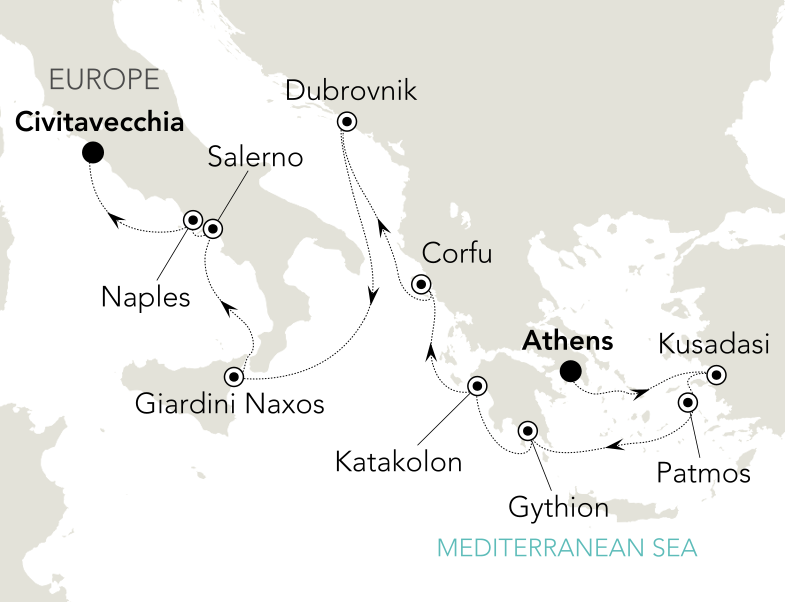
A 12-night ocean voyage aboard Silver Shadow, Athens, Greece to Civitavecchia, Italy. Destination: Mediterranean.
Operated by Silversea Cruises aboard Silver Shadow.
Athens (Piraeus)
Kusadasi
Patmos
Gythion
Katakolon (Olympia)
Corfu
Dubrovnik
Giardini Naxos (Sicily)
Salerno
Naples
Civitavecchia (Rome)
A city of legend, civilisation and enduring culture, Athens is a majestic and magical urban sprawl. Extraordinary elegance and grace combine with grit and graft in Greece's capital, where highways encase ruins from antiquity, and gleaming museums and galleries stand beside concrete sprayed with edgy street art. These contrasts enhance and elevate the wonders of this 2,500-year-old city, however, which can count notable contributions to philosophy, drama and democracy, among its global legacy. Piraeus' giant port and naval base welcome you to the edge of the Athens' urban area. From there it's a simple jaunt to the centre. The majestic ancient citadel of the Acropolis dominates an elevated platform and is a constant presence as you explore the city. The wonderful remains of the columned temple of the Parthenon - which date back to the 5th century BC - stand here, representing the pinnacle of classical architecture. The nearby Acropolis Museum adds context to your visit and frames the broad views from its giant glass windows. Or rise up Mount Lycabettus, to be rewarded with perhaps Athens' best panorama of the Acropolis sitting high over the city on its grand stage. See the marble horseshoe of the Old Olympic Stadium, where the first modern Olympics were held in 1896, for more of the city's enduring legacy. Elsewhere, golden beaches and temples stretch out along the coastline, should you wish to explore a little further afield. Coffee is an art form to the Greeks, and it's an unwritten rule that coffee time must never be rushed. So prepare to settle down for a couple of hours and lose yourself in a good chat. Feeling hungry - try traditional souvlaki made with sauces handed from generation to generation.
Days at sea are the perfect opportunity to relax unwind and catch up with what you’ve been meaning to do. So whether that is going to the gym, visiting the spa, whale watching, catching up on your reading or simply topping up your tan these blue sea days are the perfect balance to busy days spent exploring shore side.
Explore the towering columns, and storied remains of Ephesus - one of the most spectacular cities left by the Ancient Greeks. Kusadasi welcomes you to the Turkish coastline and is your base for exploring these majestic remains, which sit just 10 miles inland from the port. The Ephesus UNESCO World Heritage Site is a true archaeological gold mine, and an amazingly well-preserved site - once home to 150,000 people. The grand Temple of Artemis rose up majestically here and was recognised as one of the Seven Wonders of the Ancient World before its untimely destruction. The grand city was a fitting location for such a wonder, and with a mere 20% estimated to have been uncovered, the scale and majesty of Ephesus is hard to fully comprehend, as you walk its ancient streets. Visit the precious Library of Celsus - a gorgeous, double-layered façade of columns and artistry - and enjoy the city's gently illuminated, atmospheric venues - which still host stirring evening concerts. Ephesus's museum adds context to the 25,000 treasures that are exhibited within. After a long hot day exploring, recharge with a perfectly-charred and seasoned kebab or vegetable and rice stuffed grape leaves like dolma. In Kusadasi itself, you can discover a lively seaside city with a buzzing Aegean beach scene, and a glut of restaurants and cafes to kick back in.
The seahorse-shaped Patmos is a Greek island of stunning seascapes and immense cultural significance.Whether you’re religious or not there is something of the divine in this gorgeous island - a place of sanctuary fringed by crystal-clear waters and blissful beaches. Sleepy whitewash towns gleam in the strong sunshine while cats slink between the crumbling walls of this ruggedly beautiful island. High on the hillside above the cobalt-blue bay you’ll find the sacred chapel where an exiled John of Patmos is said to have entered the Cave of the Apocalypse and prophesied of the end of the world’s fire and brimstone – a striking juxtaposition with the peaceful serenity of the calm location. Higher up you’ll find the 11th-century Monastery of St. John which offers spectacular views of the island’s mounds curving around like a scorpion’s tail. It stands watching over the island like a fortified crown. Sun-wrinkled black-robed monks climb the streets up to this World Heritage site where bells peel out melodically. Inside vaulted chambers and stunning frescoes tell stories amid the striking religious iconography. Chora’s incredible narrow streets - moulded white - are an enchanting place to lose your bearings spreading below the monastery. Elsewhere blissful beaches stretch out across the coastline or this remote Greek island’s curves can be admired while bobbing offshore in a sailboat.
One of the most beautiful parts of this region of the Peloponnese is the plain of Laconia which extends from Sparta to the port of Gytheion. The many neo-classical houses of this harbor town are built on the slopes of Mount Kourmaros. Aside from its remaining ancient theater and cultural museum, visitors can enjoy local beaches and a variety of dining opportunities. The inhabitants of Gytheion claim Hercules and Apollo as its founders. According to mythology, Paris and Helen of Troy were reputed to have spent their first night together on nearby ancient Kranae, now called Marathonissi. Enlarging the natural harbor, it was used by the Spartans as their naval base and the main port of trade. Today Gytheion is visited mostly for its scenic beauty and access to numerous historical sites. These include the cliffside city of Mistra, one of the finest surviving examples of Byzantine architecture in Greece, and ancient Sparta. Pier Information While in Gytheion, the ship will be at anchor. Guests will be taken ashore via ship’s tender. It is a short walk to the center of town from the pier. Shopping If antiques are your thing, check out Paliatzoures Antique Shop located along the waterfront next to the Hotel Pantheon. If you plan to explore the Mani architecture, you may want to purchase the book 'Deep into Mani' by Edward Eliopoulos (Faber) or others available at the Ladopulou Bookshop in Gytheion. Cuisine Try the best of Gytheion’s seafood at the Sea Tide Restaurant, open from noon until midnight. For more casual fare, try the Touristico Cafeteria. On Tuesdays and Fridays, there is an excellent fruit and produce market located between Herakles and Archaia Theatrou Streets. Other Sites Roman Theater Explore the town’s well-preserved ancient Roman Theater. Its acoustics rate among the finest in all of Greece. Byzantine Church Ruins from a small Byzantine church that was built into the side walls of the theater can also be seen. Town Hall Another monument you can view is the Town Hall, constructed by the German architect, Tsiller. Ethnological Museum The city’s Ethnological Museum displays cultural items discovered in the area. Marathonisi Island Notice that the tiny island of Marathonisi is now permanently connected to the mainland by a concrete causeway. It was on this island that King Paris and Queen Helen once consummated their love. Beaches The best beaches in the area are Mavrovouni and Selinitsa. Kranai Island also offers an excellent beach plus an interesting Ethnological Museum. PRIVATE ARRANGEMENTS For those guests who are interested in touring at your leisure, we are pleased to offer Silver Shore Privato - both half-day and full-day private arrangements by private car. You may book this in advance at Silversea.com or it may be purchased on board, subject to availability. Other private arrangements for independent sightseeing may be arranged by emailing Concierge@silversea.com. Port Photo: Don Pugh/Flickr
Holding the torch as the spiritual home of the Olympic Games Olympia has an enduring legacy and its values echo around the world during humanity’s greatest sporting contest. Come ashore at Katakolon - a small port village on the Peloponnese peninsula facing the Ionian Sea and relax on beautiful Kourouta Beach. Or head inland through this legendary destination to the historic home of the Olympic Games. Located in the valley of the River Alfeios Olympia is a staggering archaeological site of immense ruins and enduring legacy. Visit the museum and Olympia Stadium - where the ancient games were held in honour of the Greek god Zeus. As many as 45 000 spectators fit into the mud seats to witness the ultimate contest of athleticism. See the stand where judges would sit and the white blocks where runners would line up to compete. The tradition continues stronger than ever and the Olympic flame of the modern games is ignited by the sun here in the ruins of the Temple of Hera. It is then taken to spread the Olympic values across the globe. The Temple of Zeus and the Statue of Zeus - one of the Seven Wonders of the Ancient World - also rose here in all of their glory. Hewn from limestone the temple contained the 13-metre tall statue of Zeus which was sculpted by Phidias - one of Ancient Greece's finest artists. Although the statue has been destroyed you can walk the temple's ruins and see the guesthouse where the majestic wonder was painstakingly crafted.
The soft hues of Corfu’s UNESCO World Heritage List Old Town brings together Corfu’s mesh of European influences with its romantic stone floors and vine-clad cafes. Find somewhere to settle in for a morning coffee ritual like a true Corfiat and sip at the laid-back pace of the locals - allowing the thick bitter concoction to settle before indulging. The oddly out-of-place sound of leather on willow can be heard in Spianada Square – the largest city square in the Balkan region - where a manicured cricket pitch spreads out incongruously below the Mediterranean sun. Take the hike up to the 13th-century Paleokastritsa Monastery where you’ll be escorted by the resident goats and have to step over cats contentedly rolling around your feet on arrival. Inside explore gold-framed frescoes and watch as monks squeeze oil from the monastery’s trees’ bounty. Wander out among the groves to views of Corfu’s never-ending sea reaching out to the horison below you. Corfu’s sweeping sand beaches and hidden coves display the full spectrum of vivid Mediterranean seaside colours – which shift from turquoise greens to cobalt blues. The famous Canal d’Amour is a gorgeous inlet and island legend says couples who swim together in this narrow channel of water stay together forever. Enjoy an afternoon sit-down and drink of ginger tea or something a little stronger in the form of Corfu’s famous radiant orange kumquat liqueur.
Croatia’s crowning glory rears up vertically from the tranquil waters of the Adriatic, and Dubrovnik’s daunting fortresses town is a truly imposing sight to behold. Encircled by chunky stone walls so thick and dramatic they could have been purpose-built as a film set, this city’s unmatched old town is the setting for countless films and shows - from Star Wars to Robin Hood, Game of Thrones and every production in-between seeking a truly authentic medieval flavour. This fantasy fortress’s walls - which are no less than 12-metres thick at places - are certainly not just for show, however. They kept Dubrovnik safe when it was a maritime republic and they were besieged as recently as 1991, when Serbian and Montenegrin forces attacked, as Yugoslavia broke apart. Fully restored now, the stone streets of the city take you through a beautiful mosaic of architectural splendour, baroque churches and splashing fountains. Tapering alleys rocket up from the central boulevard of Stradun, offering spectacular views down, but you’ll need to walk the city walls to appreciate the fortress city’s full scale. Banking up sharply to the rear, you can gaze across an ocean of terracotta roofs and church spires, clamouring together before the sparkling Adriatic. Visit the neighbouring fort of Lovrijenac, for another perspective, or swing up to Srd fortress’s glorious panorama on a cable car. Dubrovnik’s streets are crammed with eateries and candlelit tables, where couples splash wine into glasses and enjoy gnocchi mixed with creamy truffle sauces. Nearby beaches like Banje are also close by, and hidden bays reward the intrepid who venture out beyond the old town. Take sunset drinks to sit back and watch as flotillas of sea kayaks roll by, or sail on the pristine waters to explore island gems like Lokrum - where peacocks are the only permanent residents.
Days at sea are the perfect opportunity to relax unwind and catch up with what you’ve been meaning to do. So whether that is going to the gym, visiting the spa, whale watching, catching up on your reading or simply topping up your tan these blue sea days are the perfect balance to busy days spent exploring shore side.
Hugging a long, sweeping bay, Giardini Naxos welcomes you ashore to some of Sicily’s most scenic and historic sites. Naxos was the first Greek settlement on Sicily, and it is surrounded by remarkable remains and swirling mythology. With a long arc of sun-soaked golden sand, you can kick back by the waves - and cool off with a dip into the sea's refreshing embrace. Up above the seaside revelry, the spectacular Taormina hillside town perches - containing rich Roman and Greek history. Visit to encounter one of Sicily’s best views, as you look down over the rejuvenating blue of the sea, and the looming backdrop of Mount Etna rising in the distance. The majestic, honey-coloured Greek theatre is a highlight, standing before the distant loom of the volcano. Head towards the puffs of cloud, and wisps of smoke, that gather around the peak of Sicily’s mighty volcano, which is among the most active in Europe. Arrive through vineyards, thriving in this fertile soil, before taking the 1,737-metre incline to the summit of the legendary mountain of fire, across fields of solidified lava flows. Known to the Greeks as the home of the God of Fire, and the one-eyed Cyclops, the mountain continues to amaze and awe with its restless power. Vineyards carpet the scenery - interrupted by occasional cactai and citrus groves – and produce some of Sicily’s most refined flavours. Enjoy a glass of wine on Giardini Naxos’ seafront, and toast your time on these rich Sicilian shores
Salerno is situated at the northern end of the Gulf of Salerno. The old town, rising up the slopes of the hill on the site of the ancient Salernum, still bears evidence of its great days during the medieval period. It had the oldest medical school in Europe, which flourished from the 11th century until it was closed down by Napoleon's brother-in-law, Murat, in 1812. Today, Salerno's main attraction is an imposing Romanesque cathedral, built in 1085 and remodeled in the late 18th century. A flight of steps leads up to an atrium with 28 columns from Paestum and fourteen ancient sarcophagi. The magnificent bronze doors were made in Constantinople in 1099. Inside is the ornate tomb of Margaret of Anjou and the tomb of Pope Gregory VII, who died in Salerno in 1085. In the richly decorated crypt under the alter lie the remains of the Evangelist Matthew, brought here from Paestum.A 45-minute walk from the cathedral leads to a hilltop crowned by the old Lombard Castello, from where extensive views are available. Along the seafront, to the east of the harbor, extends a fine promenade lined with impressive modern buildings. The Corso Giuseppe Garibaldi is the town's principal traffic artery.Travelers coming to Salerno mainly use the port as a starting point for visits to the Greek temples of Paestum. Other favorite excursions from here are to Pompeii and to visit the popular resort towns of Amalfi and Ravello. Pier Information The ship is scheduled to dock at Pier 22. A tourist office is located at the port and is open from 8:00 a.m. to 1:30 p.m. From the pier it is approximately two miles to the town center. Taxis are generally available at the pier for trips farther afield. Be sure to establish the fare with the driver before starting out. Shopping Local handicrafts, clothing, shoes and mozzarella cheese are items to look for. Major shopping areas are along Via dei Mercanti, Via Duomo and Corso Vittorio Emanuele. Most shops are closed between 1:30 p.m. and 5:00 p.m. The local currency is the euro. Cuisine The always popular pasta dishes are a good choice. Other favorites include fresh seafood and local specialties. The home-produced ricotta and mozzarella are especially recommended. Good local wines will complement your meal. Other Sites Museo Diocesano At the Piazza Plebiscito, behind the cathedral, this museum houses a fine collection of medieval carved tablets. Museo Provinciale Occupying two floors of the San Benedetto Monastery, the main attraction at the museum is a handsome bronze head of Apollo fished out of the bay in the 1930s.
The legend of the Siren Parthenope Naples' foundation is not only shrouded in one but two legends, all having one 'person' in common: the siren Parthenope. She and her sisters, Leucosia and Ligaea, are the three resident sirens of the Galli Islands, with their "shores all bleached with human bones and debris", who lured sailors with their enchanting voices and music, only for them to run aground and perish. Parthenope was precisely this magical, murderous voice, while Leucosia and Ligaeus played the flute and citara. The first legend is linked to Ulysses, the first man not to succumb to the siren's call, thanks to Circe's advice. Curious but not mad, he ordered his sailors to plug their ears with wax and tie him firmly to the mast. In this way, he was able to enjoy the pleasure of hearing the music and songs without paying a high price. There are different stories here, some claiming that Parthenope fell in love with Ulysses, others not. In any case, the three sisters, in despair and humiliation, threw themselves into the sea and died. If you are surprised to read that, keep in mind that we're talking about sirens from Antiquity, young women transformed into half-woman half-bird monsters, punished by the goddess Demeter for not having stopped Hades, the god of the Underworld, from kidnapping their mistress Persephone (and daughter of Demeter). Mermaids with fish tails only appeared in the Middle Ages. So, Parthenope and her sisters perished. Their bodies were carried by the sea to Terina for Ligaea and Licosa for Leucosia. Parthenope's body was carried by the waves to the island of Megaride, Naples, where the Castel dell'Ovo stands today. She gave her name to the town and the inhabitants worshipped her, making her the town's patron saint. Another legend exists, from the 19th century. A centaur - Vesuvius - fell madly in love with our siren Parthenope, provoking the jealousy of Zeus. In revenge, he turned the centaur into a volcano. In despair, Parthenope committed suicide and her body washed up in Naples, allowing her to be close to her lover in death. Today there are three fountains dedicated to her: the Fontana delle Zizze (Neapolitan for 'nipples') beside Corso Umberto I with its winged mermaid, a second on the Piazza Jacopo Sannazzaro in Piedigrotta and a third, modern, near the shops at the Central Station. Naples is still referred to as the "Parthenopean city".
All roads lead to Rome, and with good reason - this city is one of the world’s most thrilling, offering unmatched history along every street. An evocative, inspiring and utterly artistic capital of unrivalled cultural impact, Rome is a city of back-to-back landmarks, which will take you on an exhilarating journey through the ages. This may be one of the world’s oldest cities, but it’s well and truly lived in. The ruins are punctuated with murmuring cafes, and the outdoor seating of restaurants sprawls out across piazzas, enticing you to sample tangles of creamy pasta and crispy pizzas. Rome’s incredible Roman Forum is littered with the ruins of its ancient administrations, which have stood firm for 2,000 years, since the times when the area was the centre of the Western world. Few sites are more simultaneously beautiful and haunting than that of the storied Colosseum, which looms deep into Rome’s rich blue sky. Take a tour to learn details of the grisly goings-on within. The best way to experience Rome is to wander its streets, gelato in hand. There is a lot to see here - whether it’s the domed spectacle of the Pantheon, or the elaborate flowing waters and artistry of the Trevi Fountain. Vatican City is an astonishing, colossal display of Catholic grandeur, while the Spanish Steps – crowned by the Trinità dei Monti church – offer a beautiful spot to gather and soak up the lively atmosphere of this humming city. With so much on the to-do list, you’ll relish the breaks you take, enjoying simple pleasures like a strong espresso, or fresh pasta with tomato sauce and ripped basil.
From $8,800
per guest · 12 nights
Prices are a guide and vary with season, cabin category and party size. Your advisor will confirm the exact cost before anything is booked.
Grand 1 Bedroom
suite
Grand 2 Bedroom
suite
Medallion
suite
Owner 1 Bedroom
suite
Owner 2 Bedroom
suite
Royal 1 Bedroom
suite
Royal 2 Bedroom
suite
Silver
suite
Terrace
suite
Veranda 1
suite
Veranda 2
suite
Veranda 3
suite
Veranda 4
suite
Vista
suite








