




Prefer a conversation?
Our team is always available to guide you through the process and ensure your experience is perfectly matched to your preferences.
Our team is always available to guide you through the process and ensure your experience is perfectly matched to your preferences.
Duration
10 Nights
Price
From $9,100
Ship
Silver Ray
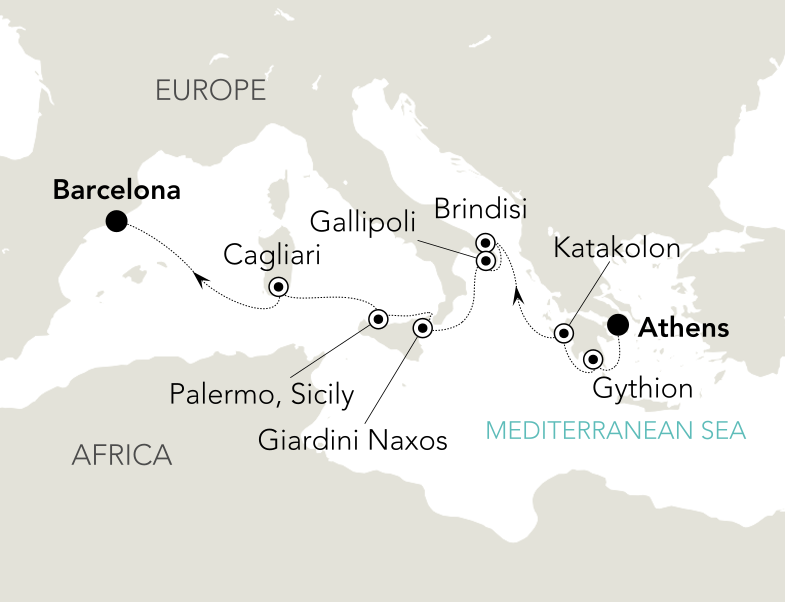
A 10-night ocean voyage aboard Silver Ray, Athens, Greece to Barcelona, Spain. Destination: Mediterranean.
Operated by Silversea Cruises aboard Silver Ray.
Athens (Piraeus)
Gythion
Katakolon (Olympia)
Brindisi
Gallipoli
Giardini Naxos (Sicily)
Palermo, Sicily
Cagliari (Sardinia)
Barcelona
A city of legend, civilisation and enduring culture, Athens is a majestic and magical urban sprawl. Extraordinary elegance and grace combine with grit and graft in Greece's capital, where highways encase ruins from antiquity, and gleaming museums and galleries stand beside concrete sprayed with edgy street art. These contrasts enhance and elevate the wonders of this 2,500-year-old city, however, which can count notable contributions to philosophy, drama and democracy, among its global legacy. Piraeus' giant port and naval base welcome you to the edge of the Athens' urban area. From there it's a simple jaunt to the centre. The majestic ancient citadel of the Acropolis dominates an elevated platform and is a constant presence as you explore the city. The wonderful remains of the columned temple of the Parthenon - which date back to the 5th century BC - stand here, representing the pinnacle of classical architecture. The nearby Acropolis Museum adds context to your visit and frames the broad views from its giant glass windows. Or rise up Mount Lycabettus, to be rewarded with perhaps Athens' best panorama of the Acropolis sitting high over the city on its grand stage. See the marble horseshoe of the Old Olympic Stadium, where the first modern Olympics were held in 1896, for more of the city's enduring legacy. Elsewhere, golden beaches and temples stretch out along the coastline, should you wish to explore a little further afield. Coffee is an art form to the Greeks, and it's an unwritten rule that coffee time must never be rushed. So prepare to settle down for a couple of hours and lose yourself in a good chat. Feeling hungry - try traditional souvlaki made with sauces handed from generation to generation.
One of the most beautiful parts of this region of the Peloponnese is the plain of Laconia which extends from Sparta to the port of Gytheion. The many neo-classical houses of this harbor town are built on the slopes of Mount Kourmaros. Aside from its remaining ancient theater and cultural museum, visitors can enjoy local beaches and a variety of dining opportunities. The inhabitants of Gytheion claim Hercules and Apollo as its founders. According to mythology, Paris and Helen of Troy were reputed to have spent their first night together on nearby ancient Kranae, now called Marathonissi. Enlarging the natural harbor, it was used by the Spartans as their naval base and the main port of trade. Today Gytheion is visited mostly for its scenic beauty and access to numerous historical sites. These include the cliffside city of Mistra, one of the finest surviving examples of Byzantine architecture in Greece, and ancient Sparta. Pier Information While in Gytheion, the ship will be at anchor. Guests will be taken ashore via ship’s tender. It is a short walk to the center of town from the pier. Shopping If antiques are your thing, check out Paliatzoures Antique Shop located along the waterfront next to the Hotel Pantheon. If you plan to explore the Mani architecture, you may want to purchase the book 'Deep into Mani' by Edward Eliopoulos (Faber) or others available at the Ladopulou Bookshop in Gytheion. Cuisine Try the best of Gytheion’s seafood at the Sea Tide Restaurant, open from noon until midnight. For more casual fare, try the Touristico Cafeteria. On Tuesdays and Fridays, there is an excellent fruit and produce market located between Herakles and Archaia Theatrou Streets. Other Sites Roman Theater Explore the town’s well-preserved ancient Roman Theater. Its acoustics rate among the finest in all of Greece. Byzantine Church Ruins from a small Byzantine church that was built into the side walls of the theater can also be seen. Town Hall Another monument you can view is the Town Hall, constructed by the German architect, Tsiller. Ethnological Museum The city’s Ethnological Museum displays cultural items discovered in the area. Marathonisi Island Notice that the tiny island of Marathonisi is now permanently connected to the mainland by a concrete causeway. It was on this island that King Paris and Queen Helen once consummated their love. Beaches The best beaches in the area are Mavrovouni and Selinitsa. Kranai Island also offers an excellent beach plus an interesting Ethnological Museum. PRIVATE ARRANGEMENTS For those guests who are interested in touring at your leisure, we are pleased to offer Silver Shore Privato - both half-day and full-day private arrangements by private car. You may book this in advance at Silversea.com or it may be purchased on board, subject to availability. Other private arrangements for independent sightseeing may be arranged by emailing Concierge@silversea.com. Port Photo: Don Pugh/Flickr
Holding the torch as the spiritual home of the Olympic Games Olympia has an enduring legacy and its values echo around the world during humanity’s greatest sporting contest. Come ashore at Katakolon - a small port village on the Peloponnese peninsula facing the Ionian Sea and relax on beautiful Kourouta Beach. Or head inland through this legendary destination to the historic home of the Olympic Games. Located in the valley of the River Alfeios Olympia is a staggering archaeological site of immense ruins and enduring legacy. Visit the museum and Olympia Stadium - where the ancient games were held in honour of the Greek god Zeus. As many as 45 000 spectators fit into the mud seats to witness the ultimate contest of athleticism. See the stand where judges would sit and the white blocks where runners would line up to compete. The tradition continues stronger than ever and the Olympic flame of the modern games is ignited by the sun here in the ruins of the Temple of Hera. It is then taken to spread the Olympic values across the globe. The Temple of Zeus and the Statue of Zeus - one of the Seven Wonders of the Ancient World - also rose here in all of their glory. Hewn from limestone the temple contained the 13-metre tall statue of Zeus which was sculpted by Phidias - one of Ancient Greece's finest artists. Although the statue has been destroyed you can walk the temple's ruins and see the guesthouse where the majestic wonder was painstakingly crafted.
Days at sea are the perfect opportunity to relax unwind and catch up with what you’ve been meaning to do. So whether that is going to the gym, visiting the spa, whale watching, catching up on your reading or simply topping up your tan these blue sea days are the perfect balance to busy days spent exploring shore side.
Set right in the heel of Italy’s boot, Brindisi is a pretty little maritime port, fringed with palm trees and most definitely carries its moniker of “Gateway to the East” with pride. An Italian province packed with fascination and the relics of vanished civilization, Brindisi’s cultural inheritance ranges from the relics of ancient Roman highways to Gothic and Baroque churches, cathedrals, frowning battlements of Swabian castles and fortresses which date back to the 13th century, reign of the Holy Roman Emperor, Frederick II. Life continues in Brindisi as if the 21st century hadn’t arrived. Visually, the landscape is as stunning as one would expect in southern Europe. Villages set on sunlit hilltops rise like islands above a rolling landscape of olive groves and vineyards. The coastline is a striking mixture of ruggedly beautiful cliffs and grottoes interspersed with a scattering of long, sandy beaches. Together with the wealth of historical artefacts and spectacular landscapes, Brindisi is one of Italy’s best kept secrets. Naturally, the cuisine is rich with its pickings from both land and sea and visitors can expect the best pasta, Caprese salad, local lemon loaf and spaghetti al vogole they have ever had!
Taking its name from the Greek translation of 'beautiful city’ Gallipoli has a big reputation to live up to. A gorgeous gem of the Ionian this is an elegant city with water running through its veins. Surrounded on three sides by the sea wander between the fish market where tables groan below hauls of fresh seashells and the harbour where little boats come and go all day long. Scooters weave along the old town's tight streets dodge them while enjoying atmospheric strolls below the dangling flowerpot-laced balconies. Enclosed by 14th-century sea walls - and linked to the mainland by a 16th-century bridge - the island is dominated by Castello Angioino di Gallipoli with its thick walls and imposing waterfront setting glaring out to sea. The grand baroque facade of the Basilica Cattedrale di Sant'Agata of 1629 stands in the centre of the old town showcasing intricate carvings and harbouring intense dark paintings and grand columns within. These sun-blessed landscapes produce a rich bounty of flavourful olives and grapes each year. The rich liquid gold of Gallipoli's olive oil is legendary and the city is pocked with underground olive oil factories squeezing out the very best flavours. Puglia has a number of charming coastal towns from the beautiful Baroque architecture of palaces and churches at Lecce to the walled city of Otranto - which waits across the peninsular looking east. This pretty old town has a charming Medieval core and its glowing beaches spread beside the Adriatic’s blue waters.
Hugging a long, sweeping bay, Giardini Naxos welcomes you ashore to some of Sicily’s most scenic and historic sites. Naxos was the first Greek settlement on Sicily, and it is surrounded by remarkable remains and swirling mythology. With a long arc of sun-soaked golden sand, you can kick back by the waves - and cool off with a dip into the sea's refreshing embrace. Up above the seaside revelry, the spectacular Taormina hillside town perches - containing rich Roman and Greek history. Visit to encounter one of Sicily’s best views, as you look down over the rejuvenating blue of the sea, and the looming backdrop of Mount Etna rising in the distance. The majestic, honey-coloured Greek theatre is a highlight, standing before the distant loom of the volcano. Head towards the puffs of cloud, and wisps of smoke, that gather around the peak of Sicily’s mighty volcano, which is among the most active in Europe. Arrive through vineyards, thriving in this fertile soil, before taking the 1,737-metre incline to the summit of the legendary mountain of fire, across fields of solidified lava flows. Known to the Greeks as the home of the God of Fire, and the one-eyed Cyclops, the mountain continues to amaze and awe with its restless power. Vineyards carpet the scenery - interrupted by occasional cactai and citrus groves – and produce some of Sicily’s most refined flavours. Enjoy a glass of wine on Giardini Naxos’ seafront, and toast your time on these rich Sicilian shores
The capital of Sicily, Palermo is a fiery, authentic city and a cultural powerhouse on the periphery of Europe. Juicy lemons weigh down the branches of its tree-lined streets, while treats like cannoli tubes, filled with ricotta-blended cream, provide a sweet taste of the local cuisine. Oozing layered character, explore this incredible city at leisure, or head out to nearby villages, which offer preserved medieval charm. Stacked markets spill out onto Palermo’s souk-like streets, while grand piazzas host elaborate fountains and sculptures, below the watch of baroque church domes. Many cultures have clashed and combined on this island’s shores, - since the days of antiquity - giving the city the dubious honour of being the world’s most conquered city. A genuine patchwork of influences, Palermo’s triumph lies in somehow combining it all into one fascinating whole. Palermo is a delightfully dishevelled city. Wander bomb-damaged streets of neglect, which suddenly open out to the grandest of cathedrals and most majestic of stunning palaces. The 12th-century Palermo Cathedral is a glorious domed structure – rise to the top, to look across the city’s restaurant-filled alleyways from above. Next, encounter the Norman, Arabic, and Byzantine fusion of the Norman Palace and the incredible golden mosaics and sweeping archways of the adjacent Royal Chapel. Visit Europe’s third-largest opera house, or Mondello’s beach, which offers relaxation on a beautiful arc of white sand. Stop in at the selection of restaurants, which serve up fresh fish, and refreshing granita al limone.
The serene sea approach to Cagliari is an exquisitely beautiful way to first lay eyes on the city’s mesmerising interplay of colour, spires and domed churches. Sat on Sardinia’s south coast, Cagliari is the island’s largest city, and a sun-blessed escape of beaches, architecture and Mediterranean food – where stress evaporates on contact. That first sight of Cagliari’s mosaic of architecture reveals much about the island’s history, and is a living document of the civilisations and influences that have passed through. Combining Byzantine churches with crumbling Roman ruins and Pisan towers, it’s an elegant, beguiling place to explore. Usher in the morning with a short, sharp espresso hit, before wandering along to San Benedetto market’s bustle, crammed full of overflowing heaps of local produce. Taste crisp, freshly-baked bread, thin shavings of sheep’s cheese, and ripe red strawberries, as you wander amid the market’s melody of good-natured bartering. The Castello quarter’s tight, flower-draped streets and salmon-hued brick buildings incline up above the Med’s softly lapping waves. Climb Bastione di Saint Remy staircase to Terrazza Umberto’s views of the turquoise Gulf of Angels. Next, Cathedral of Santa Maria awaits, with its marbled interiors, elaborate side chapels and intricately decorated crypt. Once you’ve unravelled Cagliari’s historical tapestry, Poetto Beach invites you to find a spot on almost five miles of uninterrupted sand, met by a dazzling expanse of turquoise water.
Days at sea are the perfect opportunity to relax unwind and catch up with what you’ve been meaning to do. So whether that is going to the gym, visiting the spa, whale watching, catching up on your reading or simply topping up your tan these blue sea days are the perfect balance to busy days spent exploring shore side.
Having attracted over 82 million visitors in 2017, Spain is gaining popularity as a travel destination. The country lures travellers from across the world with its promise of authenticity, charisma, and memorable moments. Spain’s culture is a celebration of the finer things in life, an expression of spirit, heritage and fun: colourful fiestas, delectable cuisine, age-defining art, music, dance, sport and so much more. Each region of the country has evolved a character of its own, meaning the country is unified by a sense of cultural multiplicity. Barcelona, the capital of Catalonia, is a masterpiece that embellishes the Spanish canvas. The fact that the Barcelona’s iconic cathedral, La Sagrada Familia, is still under construction over 141 years after construction commenced pays testament to the city’s artistic perfectionism, which pervades all aspects of life here. Apparent in the city’s architecture, layout, and cultural practices, aestheticism retains its value here. Antoni Gaudí, whose iconic style of modernist architecture is among Barcelona’s leading attractions, could perhaps be credited with designing the face of this magnificent city. Enjoy getting to know the vivacious personality behind Barcelona’s beauty.
From $9,100
per guest · 10 nights
Prices are a guide and vary with season, cabin category and party size. Your advisor will confirm the exact cost before anything is booked.
Classic Veranda
suite
Deluxe Veranda
suite
Grand 1 Bedroom
suite
Junior Grand 1 Bedroom
suite
Junior Grand 2 Bedroom
suite
Master
suite
Medallion
suite
Otium
suite
Owner 1 Bedroom
suite
Owner 2 Bedroom
suite
Premium Medallion
suite
Premium Veranda
suite
Signature
suite
Silver
suite
Superior Veranda
suite








