




Prefer a conversation?
Our team is always available to guide you through the process and ensure your experience is perfectly matched to your preferences.
Our team is always available to guide you through the process and ensure your experience is perfectly matched to your preferences.
Duration
9 Nights
Price
From $10,250
Ship
Silver Nova
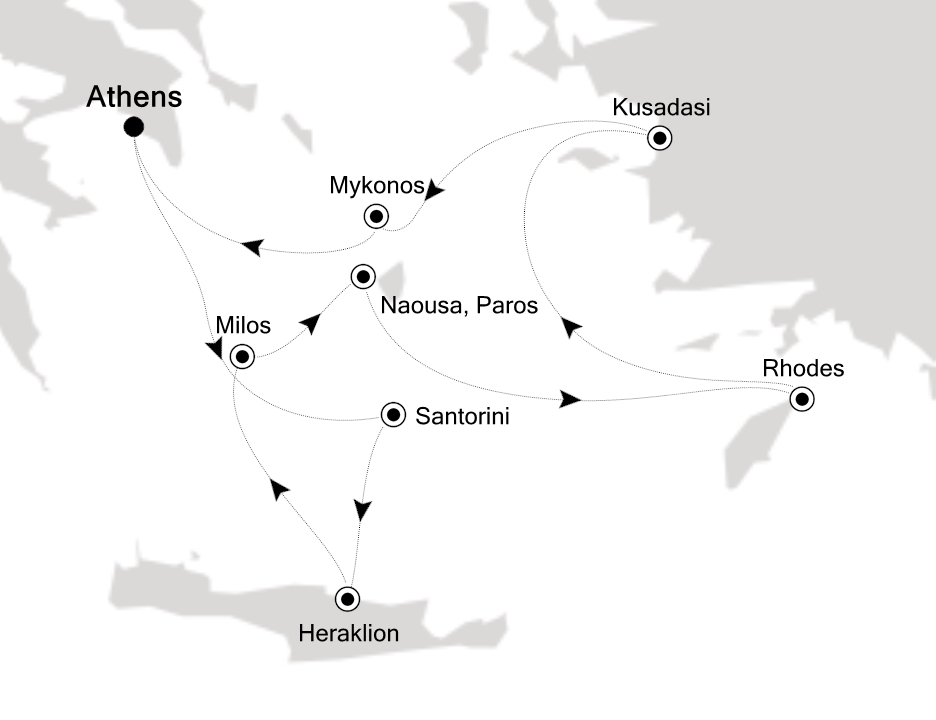
A 9-night ocean voyage aboard Silver Nova, Athens, Greece to Athens, Greece. Destination: Mediterranean.
Operated by Silversea Cruises aboard Silver Nova.
Athens (Piraeus)
Santorini
Heraklion
Milos, Nisos Melos
Paros
Rhodes
Kusadasi
Mykonos
A city of legend, civilisation and enduring culture, Athens is a majestic and magical urban sprawl. Extraordinary elegance and grace combine with grit and graft in Greece's capital, where highways encase ruins from antiquity, and gleaming museums and galleries stand beside concrete sprayed with edgy street art. These contrasts enhance and elevate the wonders of this 2,500-year-old city, however, which can count notable contributions to philosophy, drama and democracy, among its global legacy. Piraeus' giant port and naval base welcome you to the edge of the Athens' urban area. From there it's a simple jaunt to the centre. The majestic ancient citadel of the Acropolis dominates an elevated platform and is a constant presence as you explore the city. The wonderful remains of the columned temple of the Parthenon - which date back to the 5th century BC - stand here, representing the pinnacle of classical architecture. The nearby Acropolis Museum adds context to your visit and frames the broad views from its giant glass windows. Or rise up Mount Lycabettus, to be rewarded with perhaps Athens' best panorama of the Acropolis sitting high over the city on its grand stage. See the marble horseshoe of the Old Olympic Stadium, where the first modern Olympics were held in 1896, for more of the city's enduring legacy. Elsewhere, golden beaches and temples stretch out along the coastline, should you wish to explore a little further afield. Coffee is an art form to the Greeks, and it's an unwritten rule that coffee time must never be rushed. So prepare to settle down for a couple of hours and lose yourself in a good chat. Feeling hungry - try traditional souvlaki made with sauces handed from generation to generation.
Breathlessly romantic, and incredibly scenic, the azure domes and whitewash buildings that cascade down Santorini's slopes are prime honeymoon material - and relentlessly romantic. A true gem of the Cycladic island group, Santorini is startlingly pretty, and its white windmills and dazzling villages are incredibly easy on the eye. Envy-inducing and evocatively beautiful, Santorini's sunsets are legendary, and the island is a highlight of any voyage to the Greek islands. Look out over the endless expanse of blue waves, filling the massive volcanic caldera of Santorini – and absorb one of the most spectacular views in the world. The sheer rock shoulders of the caldera create an immense, natural amphitheatre - so enjoy the show, as you sip a local, volcanic-mineral enhanced white wine, and fall in love all over again. Any meal is well rounded off with the famous wine, Vinsanto. The east side of the island may lack the incredible panoramas, but it's ideal if all you want to do is recline on volcanic-sand beaches - which range in hues from charcoal-black to flame-red. This beautiful island was forged by powerful volcanic activity, and you can learn more about the huge eruption of 1,600 BCE - which wiped out the Minoan city at Akrotiri. The eruption sank the centre of the island, forming the moon-shaped topography we see now. Visit the archaeological site that has revealed and preserved the village, which was lost to time below the pumice and ash. Some whisper that this destroyed town may even be the fabled Atlantis.
It may not be the prettiest place in Crete, but Heraklion's patchwork of history, bustling activity and cultural intrigue makes it the perfect change of pace. This is certainly no sleepy island fishing village, and Greece's fifth-largest city is adorned with a rich collection of quality museums, ancient ruins from antiquity, and a lively culture of its own. A refreshing shift-up from the many quaint beach towns and fishing villages you'll encounter in the Greek islands, Heraklion – also known as Iraklio - has great shopping, extraordinary history and is the ideal base for ventures to the archaeological treasures of Crete. Traded by the Arabic, Venetian and Ottoman empires over the years, Heraklion is a multi-layered place with fascinating tales to tell. The city's impressive Venetian fortress, which waits over the gently rolling waves of the gleaming Mediterranean, welcomes you ashore. A stroll out along the seawall, alongside creaking fishing boats, will take you out to the squat fortifications that have stood since 1540. Climb to the top for views out across the water, back towards the city's waterfront. The sun-roasted earth outside the city hides treasures from the realms of history, including the Bronze Age remnants of Europe's oldest city, Knossos. A visit to the fantastic Archaeological Museum of Heraklion ties all of this history together and exhibits relics from the civilisations and eras of Crete's past. Elsewhere, Daidalou's pedestrianised paving is a charming stroll through Heraklion's shops, with streets branching off to café-lined plazas and twinkling fountains. Stop to try local food - like fresh feta and olive sprinkled dakos mezze – all washed down with a sample of local raki brandy.
Milos, one of the thousands of Greek islands, is to be found in the SW Cyclades, a large island group in the Aegean Sea. It is 86 nautical miles from Piraeus and approximately half way between Piraeus and Crete. Its surface area is 151 square kilometres and its varied coastline is 125 kilometres long. Adamas is the main port of Milos and also a seaside village of white houses shimmering on the blue waters of the Aegean. This village was founded in 1835 by refugees from Sfakia who came from Crete after the failure of their rebellion against the Turks From these times and on, Adamas became increasingly important historically because of its large, safe, naturally made harbour, and its strategic position in the eastern Mediterranean Adamas is surrounded by many beaches and offers various touristy facilities such as banks, post-office, doctors, tourist agencies, port police. Many old churches as well as mining and ecclesiastical museums are worth visiting. The geographical bearing of its capital, Plaka, is 36o 44' 35'' longitude, 24o 25' 28'' latitude. In general terms, it is a low island, whose highest peak is Prophet Elias in the north-west, rising to 751 metres. The Small Mountain in the same area is 636 metres high, while no other peak reaches over 400 metres. Its’ most characteristic feature is its magnificent gulf, providing a natural harbour, which is possibly the largest in the Mediterranean. This, in combination, with the island’s vast mineral wealth, has played and is still playing, a major role in the history, economy, culture and development of the island society throughout the last 7,000 years. Most of the inhabitants live in the 8 villages, which are in the flat, northern part of the island. These are the capital Plaka, Plakes, Triovassalos, Pera Triovassalos, Tripiti, Pollonia, Zefiria, and Adamas. Officially, Milos is part of the county of the Cyclades, whose capital is the town of Ermupolis, on the island of Syros. However, de-centralisation of the administration has been achieved by sub-dividing the county into four provinces. One of these is Milos province, incorporating the Western Cycladic islands, Kimolos, Siphnos and Seriphos and with its administrative capital on Milos. Its geological make-up, which will be dealt with later, is volcanic. However, this formation, which is different from that of the rest of the Cyclades group (with the exception of Kimolos), is the reason for the island's lack of forests, rich vegetation, natural water supplies and rivers. Never the less, it has given it colour. This unique Milos colour, is dazzlingly evident in its multitude of beautiful beaches - more than 75- with their glistening silver sand and clear blue waters. Also in the chalky white, terracotta, ochre and jet black rocks, the like of which can be seen nowhere else in the whole of Greece. CRUISE SIGHTS Church Of Agia Triada The church of Agia Triada (Holy Trinity) is located in the centre of Adamas, the port of Milos. This church dates from the 17th century and it houses a small ecclesiastical museum. Mineralogical Museum This museum was established to help promote the effects of mining in the history of Milos and to display the mineral wealth of the island. It is located at the waterfront in Adamas. Ancient Theatre This theatre was probably constructed in the Hellenistic times. However, today only the Roman phase of this monument survives. It is located close to Catacombs. CRUISE SHOPPING There are quite a few souvenir shops in Adamas and Plaka, where you can get your own copy of Aphrodite and some Greek souvenirs and local products. CRUISE ACTIVITIES Beaches: Sarakiniko - Location: 4 km east of Plaka - Location: 4 km east of Plaka Description: This beach is one of the most beautiful beaches of Milos and surely the most particular one. It is located along the coastal road east of Adamas, north-east of Milos. It is the most photographed spot of the island. Its particular landscape is very impressive and surely unforgettable: long horizontal rocks bent over the sea; those rocks are eroded by time and salt water, and have small and huge hollows all over them. The entire landscape formed by the volcanic rocks doesn't show any signs of vegetation and is coloured entirely in a bright white, which makes an interesting contrast with the deep blue and turquoise of the surrounding waters. This amazing scenery gives one the impression of standing on the surface of the moon. Agia Kiriaki- Location: 14 km south east of Plaka - Location: 14 km south east of Plaka Description: From Zefiria a road leads to the beautiful coast of Agia Kyriaki, an organized beach with pure white sand and emerald crystal-clear waters. Firiplaka – Location: 15 km south east of Plaka – Location: 15 km south east of Plaka Description: Firiplaka Beach Milos: Right next to the lovely beach of Tsigrado lies the superb beach of Firiplaka. It is a long beach with silver sand and huge coloured rocks forming its coastline. The waters in Firiplaka are really exotic: crystalline and shallow green-blue, they never fail to enchant anyone who had the chance to swim in them. Papafragas - Location: 10 km east of Plaka - Location: 10 km east of Plaka Description: After Kapros one can find the idyllic landscape of Papafragas, one of the most impressive sites of Milos. From the top of the rock, it resembles a huge natural swimming pool, an enormous cave carved out of the cliff’s side. A tiny path leads to the tiny strip of sand that forms the beach. Crystalline waters of changing colours, depending on the weather and the light, welcome the visitor and invite him to enjoy their coolness. Deep dark sea caves surround the place. The most ancient site of Milos is just a few metres away: the amazing Papafragos, the ancient town of Phylakope,. The few remaining ruins of walls, buildings and tombs are now almost entirely covered by the water, but still bear witness of the life and civilisation existing there during the Neolithic period. Provatas - Location: 13 km south east of Plaka - Location: 13 km south east of Plaka Description: The beautiful beach of Provatas is located in the south-western side of Milos. Small hotels, good restaurants and the beauty of the place are more than enough to attract many visitors every summer. Huge multi-coloured rocks, golden sand and limpid waters complete the superb image of Provatas. Tsigrado - Location: 14 km south east of Plaka - Location: 14 km south east of Plaka Description: Tsigrado is one of the most beautiful southern beaches of Milos. Located right next to Firiplaka, Tsigrado is a small sandy cove with crystal water. Going down this beach is a bit difficult as visitors have to pass through a rocky passage to get there. The surrounding environment with the rocky cliffs is quite impressive.
As one of the lesser known islands in the Aegean Sea, Paros enjoys its reputation as being the underdog of the Cyclades. Often overshadowed by Mykonos to the north, or Santorini to the south, the savvy traveller knows this island paints one of the finest pictures of Greece that you’re ever likely to find. Arrival in Paros is postcard perfect and exactly as you imagine it. Cafes and tavernas line the pretty port, bougainvillea covers narrow streets, brightly painted fishing boats bob gently in the harbour. If you arrive early enough, you’ll find the catches of the day being sold for pennies. All the touch points are there: evocative blue shuttered, white-washed houses, windmills and domed churches on the horizon, arid hillside above an azure bay that homes promise of fresh figs, olives and the seductive lullaby of cicadas. This image might seem clichéd but in Paros, it’s reality. If strolling the cobbled streets that snake into the village does not sustain your love of Greek history, then head for the Archaeological Museum in the centre of town. Paros has been inhabited since 3200 BC and has a past of maritime battles, followed by economic development and cultural flourishing. The island was well known for its fabulous marble, a fine example of which is the lovely Town Hall in Lefkes village (notably Venus de Milo was also crafted from Parian marble). Literary lovers will also know that Paros was the birthplace of Greek lyrical poet Archilochus, statues of whom can be found all over the island.
Days at sea are the perfect opportunity to relax unwind and catch up with what you’ve been meaning to do. So whether that is going to the gym, visiting the spa, whale watching, catching up on your reading or simply topping up your tan these blue sea days are the perfect balance to busy days spent exploring shore side.
Colossus of Rhodes: a colossal question mark The sixth of the Seven Wonders of the Ancient World, the Colossus of Rhodes has only been standing for a very short time. Although world-renowned, this gigantic statue is a mystery. If nothing remains of the Colossus today, its origins are documented in historical writings about the siege of Rhodes from 305-304 BC. To force the Rhodians not to support Egypt, Macedonia sent his troops to lay siege to Rhodes. Despite the construction of a 30-metre-high siege tower protected by metal plates and equipped with catapults, Rhodes held the siege for more than a year before Macedonia withdrew. To celebrate their victory and thank the gods for allowing them to resist, the inhabitants of Rhodes decided to build an extraordinary statue in honour of Helios, the Sun and protector of the island. According to the writings, it required between 12 and 13 tonnes of bronze. Some of this was salvaged from the siege tower and the rest was financed by the sale of weapons and armour abandoned by the Macedonians. The construction of the Colossus was entrusted to Charés de Lindos, a sculptor from Rhodes. It took him 12 years to complete. Sixty-five years later, in 225 or 226 BC, after having won the admiration of the world for its appearance and the technique used to build it, an earthquake caused the statue to twist at the knees and to topple to the ground its 33 metres (108ft). Although Ptolemy III of Egypt offered to finance its reconstruction, the Rhodians refused, an oracle having forbidden them to touch the remains of the Colossus. The tonnes of bronze on the ground allowed people to continue to marvel at the statue until 654, when the Umayyad Muslims dismantled his remains, whose "fingers were bigger than most statues", according to Pliny. It would have taken more than 900 camels to carry away all of its remains. Everything else is guesswork. Despite all the wonder that the statue aroused, no records of its appearance or location have come down to us. However, scientists believe that the figure depicted in the popular image with his legs spread out over the entrance to the port of Rhodes is pure invention. Technically, the structure could not have survived. It is more than likely that this marvel of engineering, almost as tall as the Statue of Liberty, had its legs squeezed together. Its location, too, remains a mystery to this day.
Explore the towering columns, and storied remains of Ephesus - one of the most spectacular cities left by the Ancient Greeks. Kusadasi welcomes you to the Turkish coastline and is your base for exploring these majestic remains, which sit just 10 miles inland from the port. The Ephesus UNESCO World Heritage Site is a true archaeological gold mine, and an amazingly well-preserved site - once home to 150,000 people. The grand Temple of Artemis rose up majestically here and was recognised as one of the Seven Wonders of the Ancient World before its untimely destruction. The grand city was a fitting location for such a wonder, and with a mere 20% estimated to have been uncovered, the scale and majesty of Ephesus is hard to fully comprehend, as you walk its ancient streets. Visit the precious Library of Celsus - a gorgeous, double-layered façade of columns and artistry - and enjoy the city's gently illuminated, atmospheric venues - which still host stirring evening concerts. Ephesus's museum adds context to the 25,000 treasures that are exhibited within. After a long hot day exploring, recharge with a perfectly-charred and seasoned kebab or vegetable and rice stuffed grape leaves like dolma. In Kusadasi itself, you can discover a lively seaside city with a buzzing Aegean beach scene, and a glut of restaurants and cafes to kick back in.
Indulge in idyllic island life, as you take your fill of superb foods and wines, and soak in endless views of sweeping turquoise seascapes and pretty whitewash buildings. Known for its lively nightlife and rejuvenating, care-free outlook, Mykonos is a dazzlingly beautiful island escape. The secret is well and truly out, but nonetheless, Mykonos has managed to retain the enduring, exclusive allure that first drew celebrities like Brigitte Bardot to its star-studded shores. True to its roots, Mykonos is a rich land of culture, tradition and swirling legend, and the island is said to be built on the frozen bodies of giants slain by Hercules and to have been the legendary battleground between Zeus and the Titans. Head out onto the crystalline waters to seek out serene islands, hit perfect beaches, or venture into the labyrinth of Mykonos Town. White facades, red roofs and cobalt blue shutters add to this lively town’s appeal. Explore narrow streets housing studios – where artisans piece together mosaics - and plenty of restaurants and bars offer sanctuary. Head to Little Venice for a waterfront view of one of the island’s famed sunsets, and to enjoy an aperitif of the favourite aniseed liqueur, ouzo. Boasting numerous attractive sandy coves, a wealth of top-notch restaurants, and rich cultural appeal, it’s little wonder that Mykonos is one of the most popular Greek Islands. Discover this jaw-droppingly scenic island paradise, watched over by its iconic huddles of picturesque windmills.
A city of legend, civilisation and enduring culture, Athens is a majestic and magical urban sprawl. Extraordinary elegance and grace combine with grit and graft in Greece's capital, where highways encase ruins from antiquity, and gleaming museums and galleries stand beside concrete sprayed with edgy street art. These contrasts enhance and elevate the wonders of this 2,500-year-old city, however, which can count notable contributions to philosophy, drama and democracy, among its global legacy. Piraeus' giant port and naval base welcome you to the edge of the Athens' urban area. From there it's a simple jaunt to the centre. The majestic ancient citadel of the Acropolis dominates an elevated platform and is a constant presence as you explore the city. The wonderful remains of the columned temple of the Parthenon - which date back to the 5th century BC - stand here, representing the pinnacle of classical architecture. The nearby Acropolis Museum adds context to your visit and frames the broad views from its giant glass windows. Or rise up Mount Lycabettus, to be rewarded with perhaps Athens' best panorama of the Acropolis sitting high over the city on its grand stage. See the marble horseshoe of the Old Olympic Stadium, where the first modern Olympics were held in 1896, for more of the city's enduring legacy. Elsewhere, golden beaches and temples stretch out along the coastline, should you wish to explore a little further afield. Coffee is an art form to the Greeks, and it's an unwritten rule that coffee time must never be rushed. So prepare to settle down for a couple of hours and lose yourself in a good chat. Feeling hungry - try traditional souvlaki made with sauces handed from generation to generation.
From $10,250
per guest · 9 nights
Prices are a guide and vary with season, cabin category and party size. Your advisor will confirm the exact cost before anything is booked.
Classic Veranda
suite
Deluxe Veranda
suite
Grand 1 Bedroom
suite
Junior Grand 1 Bedroom
suite
Junior Grand 2 Bedroom
suite
Master
suite
Medallion
suite
Otium
suite
Owner 1 Bedroom
suite
Owner 2 Bedroom
suite
Premium Medallion
suite
Premium Veranda
suite
Signature
suite
Silver
suite
Superior Veranda
suite








