




Prefer a conversation?
Our team is always available to guide you through the process and ensure your experience is perfectly matched to your preferences.
Our team is always available to guide you through the process and ensure your experience is perfectly matched to your preferences.
Duration
10 Nights
Price
From $6,650
Ship
Silver Shadow
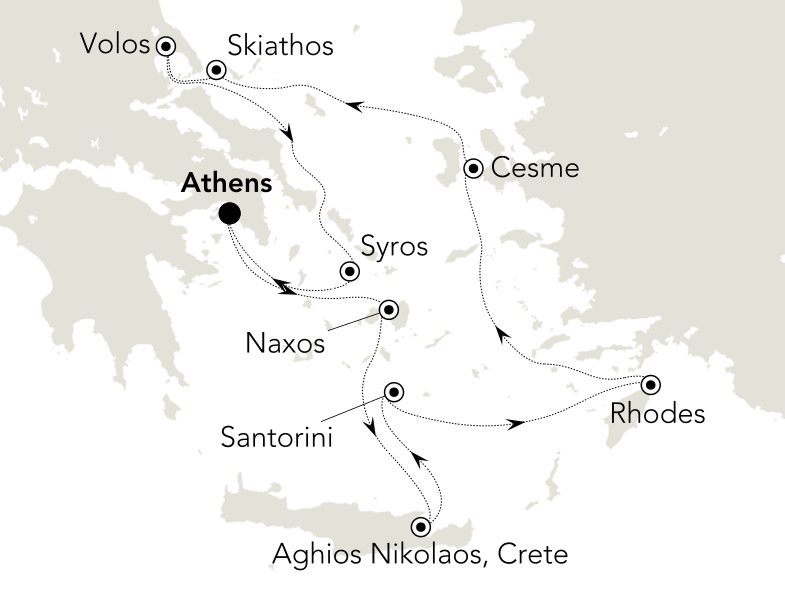
A 10-night ocean voyage aboard Silver Shadow, Athens, Greece to Athens, Greece. Destination: Mediterranean.
Operated by Silversea Cruises aboard Silver Shadow.
Athens (Piraeus)
Naxos
Aghios Nikolaos, Crete
Santorini
Rhodes
Cesme
Skiathos
Volos
Syros
A city of legend, civilisation and enduring culture, Athens is a majestic and magical urban sprawl. Extraordinary elegance and grace combine with grit and graft in Greece's capital, where highways encase ruins from antiquity, and gleaming museums and galleries stand beside concrete sprayed with edgy street art. These contrasts enhance and elevate the wonders of this 2,500-year-old city, however, which can count notable contributions to philosophy, drama and democracy, among its global legacy. Piraeus' giant port and naval base welcome you to the edge of the Athens' urban area. From there it's a simple jaunt to the centre. The majestic ancient citadel of the Acropolis dominates an elevated platform and is a constant presence as you explore the city. The wonderful remains of the columned temple of the Parthenon - which date back to the 5th century BC - stand here, representing the pinnacle of classical architecture. The nearby Acropolis Museum adds context to your visit and frames the broad views from its giant glass windows. Or rise up Mount Lycabettus, to be rewarded with perhaps Athens' best panorama of the Acropolis sitting high over the city on its grand stage. See the marble horseshoe of the Old Olympic Stadium, where the first modern Olympics were held in 1896, for more of the city's enduring legacy. Elsewhere, golden beaches and temples stretch out along the coastline, should you wish to explore a little further afield. Coffee is an art form to the Greeks, and it's an unwritten rule that coffee time must never be rushed. So prepare to settle down for a couple of hours and lose yourself in a good chat. Feeling hungry - try traditional souvlaki made with sauces handed from generation to generation.
A little bit more rough and ready around the edges than a lot of other Greek islands, Naxos is the thinking-person’s Greece. The largest of all the Cyclades islands, it was once the cultural centre of Classical Greece and Byzantium, so do not be surprised that the world’s oldest culture has left its mark. Museums range from the Archaeological Museum (housed in an elegant Venetian mansion), an impressive geological museum to the lovely Venetian and unusual museum, housed in an 800-year old private house. For those who want to venture further afield, Haki, the old capital of Naxos, has a great distillery museum, run by the same family who first opened it in 1896. Not only are there two lovely monasteries worth visiting, but because of its high mountains Naxos benefits from much more rainfall than most other Greek islands, which makes the land very green and fertile. Local produces includes olives, grapes, figs, citrus fruit, corn and potatoes and if you get a chance, a healthy home-grown meal in a back-country taverna will be undoubtedly be memorable. The golden sands that circle Naxos are particularly nice, catering for all personality types. The active among you will certainly want to head to the eastern side of the island, where the wind is perfect for budding kite and windsurfers, as well as those who like their beaches as natural as can be. The western side of the island, notably Platka beach, is where the sun-lovers will be seen soaking up the rays.
Set on the east of the Greek island Crete Aghios Nikolaos is a place of legend and luxury. Pastel-coloured houses jostle attractively around the pretty harbour and inky lake while busy restaurants and cafes spill out onto its lively waterfront. Life here orbits around Lake Voulismeni and the legendary lake is said to be bottomless and to have been a bathing spot for Greek goddesses Athena and Artemis. Enjoy heavenly views of the water through frames of pretty violet flowers or climb the stone steps for a sweeping panorama of the town lake and seas beyond. With abundant waterfront hours meander past effortlessly in the town’s humming cafes as characters come and go and sunlight flicks off the sparkling waves. Aghios Nikolaos is surrounded by wide scenic beaches and you can choose between Voulisma - where crystal-clear water lolls against fine sand or Almyros – where a refreshing ribbon of cooling freshwater snakes out into warm turquoise seawater. Away from the beaches look for the brightly-frescoed Panagias Keras Church - one of the region’s oldest Byzantine churches - which dates back to the 13th century. Explore local farms to taste fresh oil crushed from plump olives ripened by the generous Cretan sun.
Breathlessly romantic, and incredibly scenic, the azure domes and whitewash buildings that cascade down Santorini's slopes are prime honeymoon material - and relentlessly romantic. A true gem of the Cycladic island group, Santorini is startlingly pretty, and its white windmills and dazzling villages are incredibly easy on the eye. Envy-inducing and evocatively beautiful, Santorini's sunsets are legendary, and the island is a highlight of any voyage to the Greek islands. Look out over the endless expanse of blue waves, filling the massive volcanic caldera of Santorini – and absorb one of the most spectacular views in the world. The sheer rock shoulders of the caldera create an immense, natural amphitheatre - so enjoy the show, as you sip a local, volcanic-mineral enhanced white wine, and fall in love all over again. Any meal is well rounded off with the famous wine, Vinsanto. The east side of the island may lack the incredible panoramas, but it's ideal if all you want to do is recline on volcanic-sand beaches - which range in hues from charcoal-black to flame-red. This beautiful island was forged by powerful volcanic activity, and you can learn more about the huge eruption of 1,600 BCE - which wiped out the Minoan city at Akrotiri. The eruption sank the centre of the island, forming the moon-shaped topography we see now. Visit the archaeological site that has revealed and preserved the village, which was lost to time below the pumice and ash. Some whisper that this destroyed town may even be the fabled Atlantis.
Colossus of Rhodes: a colossal question mark The sixth of the Seven Wonders of the Ancient World, the Colossus of Rhodes has only been standing for a very short time. Although world-renowned, this gigantic statue is a mystery. If nothing remains of the Colossus today, its origins are documented in historical writings about the siege of Rhodes from 305-304 BC. To force the Rhodians not to support Egypt, Macedonia sent his troops to lay siege to Rhodes. Despite the construction of a 30-metre-high siege tower protected by metal plates and equipped with catapults, Rhodes held the siege for more than a year before Macedonia withdrew. To celebrate their victory and thank the gods for allowing them to resist, the inhabitants of Rhodes decided to build an extraordinary statue in honour of Helios, the Sun and protector of the island. According to the writings, it required between 12 and 13 tonnes of bronze. Some of this was salvaged from the siege tower and the rest was financed by the sale of weapons and armour abandoned by the Macedonians. The construction of the Colossus was entrusted to Charés de Lindos, a sculptor from Rhodes. It took him 12 years to complete. Sixty-five years later, in 225 or 226 BC, after having won the admiration of the world for its appearance and the technique used to build it, an earthquake caused the statue to twist at the knees and to topple to the ground its 33 metres (108ft). Although Ptolemy III of Egypt offered to finance its reconstruction, the Rhodians refused, an oracle having forbidden them to touch the remains of the Colossus. The tonnes of bronze on the ground allowed people to continue to marvel at the statue until 654, when the Umayyad Muslims dismantled his remains, whose "fingers were bigger than most statues", according to Pliny. It would have taken more than 900 camels to carry away all of its remains. Everything else is guesswork. Despite all the wonder that the statue aroused, no records of its appearance or location have come down to us. However, scientists believe that the figure depicted in the popular image with his legs spread out over the entrance to the port of Rhodes is pure invention. Technically, the structure could not have survived. It is more than likely that this marvel of engineering, almost as tall as the Statue of Liberty, had its legs squeezed together. Its location, too, remains a mystery to this day.
Days at sea are the perfect opportunity to relax unwind and catch up with what you’ve been meaning to do. So whether that is going to the gym, visiting the spa, whale watching, catching up on your reading or simply topping up your tan these blue sea days are the perfect balance to busy days spent exploring shore side.
Though the harbor is picturesque from a distance—especially from a ferry docking at sunset, when a violet-orange light casts a soft glow and the lights on the hills behind the quay start twinkling like faint stars—Skiathos town close-up has few buildings of any distinction. Many traditional houses were burned by the Germans in 1944, and postwar development has pushed up cement apartments between the pleasant, squat, red-roof older houses. Magenta bougainvillea, sweet jasmine, and the casual charm of brightly painted balconies and shutters camouflage most of the eyesores as you wander through the narrow lanes and climb up the steep steps that serve as streets. Activity centers on the waterfront or on Papadiamantis, the main drag, with banks, travel agents, telephones, post offices, police and tourist police stations, plus myriad cafés, fast-food joints, postcard stands, tacky souvenir shops, tasteful jewelry stores, and car- and bike-rental establishments. Shops, bars, and restaurants line the cobbled side streets, where you can also spot the occasional modest hotel and rooms-to-rent signs. The east side of the port (more commonly known as the new port), where the larger boats and Flying Dolphin hydrofoils dock, is not as interesting. The little church and clock tower of Ayios Nikolaos watch over it from a hill reached by steps so steep they're almost perpendicular to the earth. Arts/Entertainment Cinema Attikon To enjoy the silver screen under the summer stars spend a few hours at Attikon Cinema, which screens three different films per week and two English language films per night (with a regular tribute to Mamma Mia), from 9 pm on. Dining Ta Psarädika You can't get any closer to the fish market than this family-run taverna, and the fresh seafood dishes (served grilled or fried) prove it. Sit outside facing the sea and sip an icy ouzo while sampling a variety of mezedes (appetizers), or if you prefer a heartier meal, try some of the finny creatures: mussels steamed in wine, or the taverna's specialty of fresh swordfish with a rosemary, garlic, raisin and honey sauce, or a seafood pasta with tomato sauce. Psaradika also serve fresh and boiled salads, grilled meats and a few traditional home-style dishes like the oil-based ladera stuffed tomatoes and a creamy moussaka. Don Quijote Tapas Bar Restaurant The tapas bar, a rare type of restaurant to find not only on Skiathos but in the country overall, will provide you with a pleasant change of flavor and scene. Its colorful selection of hot and cold tapas includes classic Spanish eats such as paella and jamon (Spanish crude ham) as well as Greek-inspired appetizers, to be savored with a local or Spanish wine, or a refreshing mojito. Try also the tuna tartare, made with fresh local tuna and seasoned with a zingy lime and coriander dressing. The Catalan cream (a Spanish version of crème brûlée) or the chocolate soufflé make for two sweet finales. A friendly waitstaff is happy is happy to advise you on dishes as you take in the expansive harbor view, intoxicated by the lively atmosphere—but not the noise—of the main town below. Amphiliki Set on a balcony overlooking Siferi bay, this restaurant, open throughout the day, pairs an inviting ozonic breeze with one of the most sprawling views in town. The menu is focused on fresh local fish, and the latest additions to the menu are an entrée of fresh tuna fillet sautéed with onion and lemon and "Chef" mussels cooked in a mustard and feta sauce. Owner Christos takes pride in the organic vegetables he serves, which are all sourced from his own garden. Service is attentive and the white house wine crisp and refreshing. Leave space for the feather-light traditional ekmek (custard cake) with mastic ice cream or try the restaurant's cheesecake if you prefer a more western dessert. The Windmill Escape the buzz of Skopelos town by climbing up the hill above Ayios Nikolaos to dine at this well restored 1880s mill–turned–unpretentiously elegant restaurant. Run by Scottish Karen McCann, the Windmill offers the town's most awesome views of the moonlit harbor accompanied by a gourmet rendition of British pub dishes with a breezy Mediterranean and southeast Asian twist. Start with the calamari with Parmesan crumb, chilli, and ginger dip, then sample the popular char-grilled fillet of beef (with a choice of sauces such as peppercorn or mushroom and bacon) before ending with a rich dessert. The Windmill has a little balcony that seats two, which places diners at the highest spot above the town; if you'd like to dine at new heights, book this coveted perch way in advance. Nightlife Slip Inn Slip Inn is liked for its good coffee during the day while at night it transforms into a funky lounge where passion-fruit margaritas are best enjoyed resting on one elbow, Dionysian style, on multicolor floor cushions. Kentavros Bar The popular Kentavros Bar entertains a young professional crowd with rhythm and blues, funk, soul, and classic rock starting at 9:30 pm. Rock 'n' Roll Rock 'n' Roll, located at the far eastern end of the harbor, is a trendy bar that serves more than 100 exotic cocktails to a mainly youthful crowd and has a DJ from 9:30 pm. Kahlua For late-night action along a row of hopping clubs, head to Kahlua, which has indoor and outdoor dancing and is open in summer until at least 3 am. Bourtzi Café For a real change of pace take a gentle stroll to a lesser known café/bar at the tip of the Bourtzi fortress' promontory. Here, like the locals, you can enjoy an affordable seaside drink away from the madding crowds. Shopping Seraïna Greek jewelry, original-looking glass lampshades, and a variety of ceramic plates are among the wares here. Galerie Varsakis Kilims, embroideries, jewelry, icons, and hundreds of antiques from around the world are available here, all set off by proprietor Charalambos Varsaki's impressive surrealistic paintings and prints. Also noteworthy is his collection of guns and swords dating to 1780-1820 and used in the Greek War of Independence. Simos Jewellery in 14 karat and 18 karat yellow and white gold, and more recently in silver, are Simos specialties, from simple designs to classical Greece-inspired baubles encrusted with precious stones. Phaedra Celebrating jewellery-making with an artsy twist, Phaedra showcases silver and gold pieces that are part of collections by noteworthy Greek designers. Sights Papadiamantis Museum The House of Papadiamantis is a tribute to one of Greece's finest writers, Alexandros Papadiamantis (1851–1911), lauded by some as "the Greek Dostoyevsky." His native Skiathos played a prominent role in his essays, short stories, and novels, as did plots strongly inspired by the human condition, war, pirate invasions, the Greek Orthodox faith, captivity, and simple rural life. Several of his novels have been translated into English, including the internationally acclaimed The Murderess. The exhibits here deal with the author's daily life, ranging from his furniture and personal belongings to vintage photographs. Bourtzi A lovely physical feature of Skiathos harbor—standing on a small, piny peninsula that divides the main port—the Bourtzi was a fortress built in 1207 by the Venetian Gyzi brothers to protect Skiathos from pirate attacks. Not much remains of the original building, also called "the castle of St. George," yet the cultural center here hosts wonderful events every summer, particularly in July and August, when art and antiquities exhibitions and open-air performances entertain tourists and locals alike. It's well worth taking in the view of the harbor from the tranquil, refreshing spots found here; west of the waterfront you'll see the fishing port where caïques come and go. The sidewalk is increasingly filled with cafés and ouzeris(ouzo bars) and, at the far end of the port beginning at the square and set around the 1846 church of Trion Hierarchon, more elegant restaurants spread out under awnings. There is also a café-bar at the Bourtzi itself.
Nestled ideally between the gentle lapping waves of the Pagasetic Gulf and Mount Pelion, Volos is a Greek seaside town worth visiting. The town enjoys a near mythic status as being home of Jason and his Argonauts, and that, along with its reputation for being ‘Land of the Centaurs’ should go some way to illustrating the degree of ancient history to be found in Volos. The city was severely damaged in an earthquake in 1955 which regrettably means that much of the 19th-century architecture has been lost or damaged. A few traces do remain however, fine examples of neo-classical architecture that are hidden away around the town. If you want your history a little older than that, the superb archaeology museum will both surprise and delight you. Not only will you find objects from the Ancient Greek era but recent excavations have unearthed artefacts from the first Neolithic settlements of Dimini and Sesklo. The city itself is flat and easy to negotiate on foot. Or better still, make like the locals and hire a bike to cycle the city. For those feeling a little more adventurous, the 8-mile cycle up Mont Pelion rewards the sporty cycler with traditional stone tavernas and breathtaking views of the region. If relaxing closer to home is more your glass of ouzo, make for Palia, the old part of Volos, famous for having some of the finest cuisine on the mainland. Head into the narrow alleys, order a tsipouradika (a combination of traditional spirit served with local mezze) and enjoy.
Beautiful sea crisp white beaches and charming medieval villages add character and colour to this gorgeous Greek Island. Part of the Cyclades group of islands visit the capital Ermoupoli to discover a network of picturesque narrow streets and winding alleyways - dotted with fancy old Venetian mansions and elegant domed churches. The colourful town cascades down to an open waterfront of pine-trees and beautiful views. Head to the sparkling marbled central square overlooked by the Town Hall and surrounded by a celebrated collection of neoclassical buildings facing up across narrow streets. A town of peeking bell towers and cobalt-blue domed churches - stop by the Church of the Assumption which treasures an original El Greco wonder inside. Further up you'll find the small monastery-sprinkled medieval village of Ano Syros. Settled on a hill it offers a glorious view down over the port and white dwellings of Ermoupoli below. You can visit Capuchin Monastery which was built in the 16th century to help the underprivileged. Encounter the Vamvakaris Museum dedicated to Markos Vamvakaris a famous rebetiko musician born here in 1905. Of course Syros is also surrounded by plenty of blissful beaches if you'd rather hit the sands. Finikas beach is nearby and a long luxurious stretch complete with sunbeds and umbrellas. Perfect for catching some sun and shade and watching the blue seawater twinkling.
A city of legend, civilisation and enduring culture, Athens is a majestic and magical urban sprawl. Extraordinary elegance and grace combine with grit and graft in Greece's capital, where highways encase ruins from antiquity, and gleaming museums and galleries stand beside concrete sprayed with edgy street art. These contrasts enhance and elevate the wonders of this 2,500-year-old city, however, which can count notable contributions to philosophy, drama and democracy, among its global legacy. Piraeus' giant port and naval base welcome you to the edge of the Athens' urban area. From there it's a simple jaunt to the centre. The majestic ancient citadel of the Acropolis dominates an elevated platform and is a constant presence as you explore the city. The wonderful remains of the columned temple of the Parthenon - which date back to the 5th century BC - stand here, representing the pinnacle of classical architecture. The nearby Acropolis Museum adds context to your visit and frames the broad views from its giant glass windows. Or rise up Mount Lycabettus, to be rewarded with perhaps Athens' best panorama of the Acropolis sitting high over the city on its grand stage. See the marble horseshoe of the Old Olympic Stadium, where the first modern Olympics were held in 1896, for more of the city's enduring legacy. Elsewhere, golden beaches and temples stretch out along the coastline, should you wish to explore a little further afield. Coffee is an art form to the Greeks, and it's an unwritten rule that coffee time must never be rushed. So prepare to settle down for a couple of hours and lose yourself in a good chat. Feeling hungry - try traditional souvlaki made with sauces handed from generation to generation.
From $6,650
per guest · 10 nights
Prices are a guide and vary with season, cabin category and party size. Your advisor will confirm the exact cost before anything is booked.
Grand 1 Bedroom
suite
Grand 2 Bedroom
suite
Medallion
suite
Owner 1 Bedroom
suite
Owner 2 Bedroom
suite
Royal 1 Bedroom
suite
Royal 2 Bedroom
suite
Silver
suite
Terrace
suite
Veranda 1
suite
Veranda 2
suite
Veranda 3
suite
Veranda 4
suite
Vista
suite








