




Prefer a conversation?
Our team is always available to guide you through the process and ensure your experience is perfectly matched to your preferences.
Our team is always available to guide you through the process and ensure your experience is perfectly matched to your preferences.
Duration
7 Nights
Price
From $8,100
Ship
Silver Nova
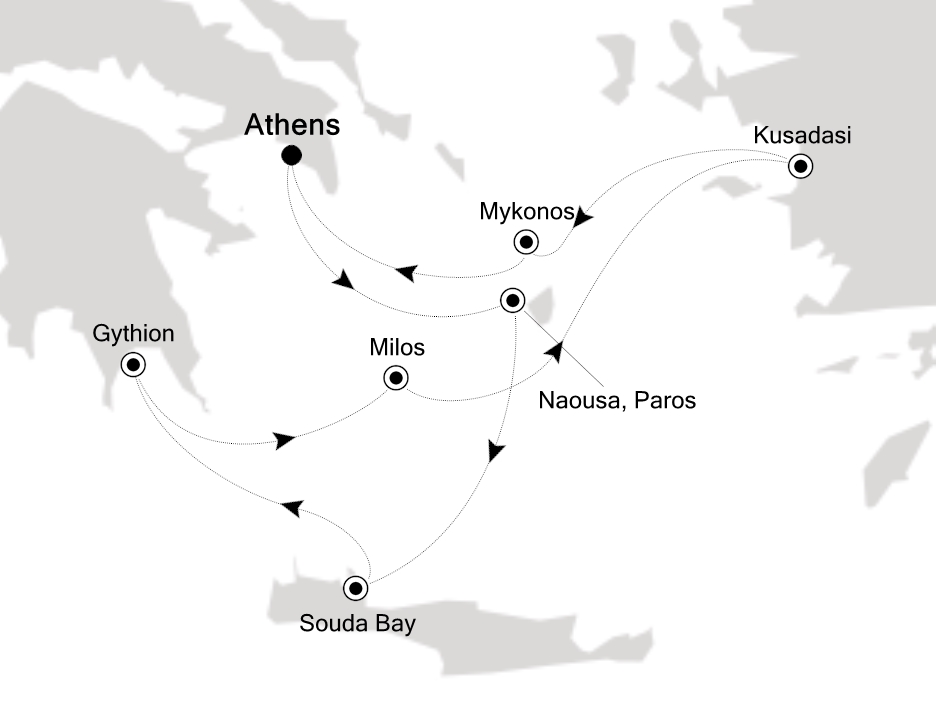
A 7-night ocean voyage aboard Silver Nova, Athens, Greece to Athens, Greece. Destination: Mediterranean.
Operated by Silversea Cruises aboard Silver Nova.
Athens (Piraeus)
Paros
Souda Bay (Crete)
Milos, Nisos Melos
Kusadasi
Mykonos
Gythion
A city of legend, civilisation and enduring culture, Athens is a majestic and magical urban sprawl. Extraordinary elegance and grace combine with grit and graft in Greece's capital, where highways encase ruins from antiquity, and gleaming museums and galleries stand beside concrete sprayed with edgy street art. These contrasts enhance and elevate the wonders of this 2,500-year-old city, however, which can count notable contributions to philosophy, drama and democracy, among its global legacy. Piraeus' giant port and naval base welcome you to the edge of the Athens' urban area. From there it's a simple jaunt to the centre. The majestic ancient citadel of the Acropolis dominates an elevated platform and is a constant presence as you explore the city. The wonderful remains of the columned temple of the Parthenon - which date back to the 5th century BC - stand here, representing the pinnacle of classical architecture. The nearby Acropolis Museum adds context to your visit and frames the broad views from its giant glass windows. Or rise up Mount Lycabettus, to be rewarded with perhaps Athens' best panorama of the Acropolis sitting high over the city on its grand stage. See the marble horseshoe of the Old Olympic Stadium, where the first modern Olympics were held in 1896, for more of the city's enduring legacy. Elsewhere, golden beaches and temples stretch out along the coastline, should you wish to explore a little further afield. Coffee is an art form to the Greeks, and it's an unwritten rule that coffee time must never be rushed. So prepare to settle down for a couple of hours and lose yourself in a good chat. Feeling hungry - try traditional souvlaki made with sauces handed from generation to generation.
As one of the lesser known islands in the Aegean Sea, Paros enjoys its reputation as being the underdog of the Cyclades. Often overshadowed by Mykonos to the north, or Santorini to the south, the savvy traveller knows this island paints one of the finest pictures of Greece that you’re ever likely to find. Arrival in Paros is postcard perfect and exactly as you imagine it. Cafes and tavernas line the pretty port, bougainvillea covers narrow streets, brightly painted fishing boats bob gently in the harbour. If you arrive early enough, you’ll find the catches of the day being sold for pennies. All the touch points are there: evocative blue shuttered, white-washed houses, windmills and domed churches on the horizon, arid hillside above an azure bay that homes promise of fresh figs, olives and the seductive lullaby of cicadas. This image might seem clichéd but in Paros, it’s reality. If strolling the cobbled streets that snake into the village does not sustain your love of Greek history, then head for the Archaeological Museum in the centre of town. Paros has been inhabited since 3200 BC and has a past of maritime battles, followed by economic development and cultural flourishing. The island was well known for its fabulous marble, a fine example of which is the lovely Town Hall in Lefkes village (notably Venus de Milo was also crafted from Parian marble). Literary lovers will also know that Paros was the birthplace of Greek lyrical poet Archilochus, statues of whom can be found all over the island.
Enter Souda Bay to land on Greece’s largest island and explore the sun-soaked charms of this fascinating land of legends landscapes and luxuries. Packed with beautiful beaches and rich maritime history Souda Bay’s huge natural harbour is a spectacular entrance opening up the treasures of Crete’s many well-stocked museums rich archaeological sites and charming Venetian fishing towns. The massive natural harbour of Souda Bay also makes the site an interesting spot for military history - with a huge NATO base here as well as the Souda Bay War Cemetery which honours Allied soldiers of World War II. Soak up some Mediterranean sunshine by heading straight to one of the luxurious white sand beaches - where you can recline to a soundtrack of fizzing waves and dine with sparkling sea views stretching out before you. Explore olive groves producing golden oil and savour the deep fruity flavours. The island's renowned wineries also invite you to sample lovingly-crafted Vilana grape wines. Rethymnon’s old town and star-shaped seafront fortress are impressive sites to explore or you can head to Akrotiri to discover the Arkadi Monastery's role in the Cretan resistance - and visit the site where the Greek flag was hoisted high into the sky by rebels in 1897. Crete retains its independent spirit but has gathered countless influences over its history. The island’s most beautiful Venetian port - Chania - is close by and its picturesque old town and collage of historical influences are a highlight of any trip.
Milos, one of the thousands of Greek islands, is to be found in the SW Cyclades, a large island group in the Aegean Sea. It is 86 nautical miles from Piraeus and approximately half way between Piraeus and Crete. Its surface area is 151 square kilometres and its varied coastline is 125 kilometres long. Adamas is the main port of Milos and also a seaside village of white houses shimmering on the blue waters of the Aegean. This village was founded in 1835 by refugees from Sfakia who came from Crete after the failure of their rebellion against the Turks From these times and on, Adamas became increasingly important historically because of its large, safe, naturally made harbour, and its strategic position in the eastern Mediterranean Adamas is surrounded by many beaches and offers various touristy facilities such as banks, post-office, doctors, tourist agencies, port police. Many old churches as well as mining and ecclesiastical museums are worth visiting. The geographical bearing of its capital, Plaka, is 36o 44' 35'' longitude, 24o 25' 28'' latitude. In general terms, it is a low island, whose highest peak is Prophet Elias in the north-west, rising to 751 metres. The Small Mountain in the same area is 636 metres high, while no other peak reaches over 400 metres. Its’ most characteristic feature is its magnificent gulf, providing a natural harbour, which is possibly the largest in the Mediterranean. This, in combination, with the island’s vast mineral wealth, has played and is still playing, a major role in the history, economy, culture and development of the island society throughout the last 7,000 years. Most of the inhabitants live in the 8 villages, which are in the flat, northern part of the island. These are the capital Plaka, Plakes, Triovassalos, Pera Triovassalos, Tripiti, Pollonia, Zefiria, and Adamas. Officially, Milos is part of the county of the Cyclades, whose capital is the town of Ermupolis, on the island of Syros. However, de-centralisation of the administration has been achieved by sub-dividing the county into four provinces. One of these is Milos province, incorporating the Western Cycladic islands, Kimolos, Siphnos and Seriphos and with its administrative capital on Milos. Its geological make-up, which will be dealt with later, is volcanic. However, this formation, which is different from that of the rest of the Cyclades group (with the exception of Kimolos), is the reason for the island's lack of forests, rich vegetation, natural water supplies and rivers. Never the less, it has given it colour. This unique Milos colour, is dazzlingly evident in its multitude of beautiful beaches - more than 75- with their glistening silver sand and clear blue waters. Also in the chalky white, terracotta, ochre and jet black rocks, the like of which can be seen nowhere else in the whole of Greece. CRUISE SIGHTS Church Of Agia Triada The church of Agia Triada (Holy Trinity) is located in the centre of Adamas, the port of Milos. This church dates from the 17th century and it houses a small ecclesiastical museum. Mineralogical Museum This museum was established to help promote the effects of mining in the history of Milos and to display the mineral wealth of the island. It is located at the waterfront in Adamas. Ancient Theatre This theatre was probably constructed in the Hellenistic times. However, today only the Roman phase of this monument survives. It is located close to Catacombs. CRUISE SHOPPING There are quite a few souvenir shops in Adamas and Plaka, where you can get your own copy of Aphrodite and some Greek souvenirs and local products. CRUISE ACTIVITIES Beaches: Sarakiniko - Location: 4 km east of Plaka - Location: 4 km east of Plaka Description: This beach is one of the most beautiful beaches of Milos and surely the most particular one. It is located along the coastal road east of Adamas, north-east of Milos. It is the most photographed spot of the island. Its particular landscape is very impressive and surely unforgettable: long horizontal rocks bent over the sea; those rocks are eroded by time and salt water, and have small and huge hollows all over them. The entire landscape formed by the volcanic rocks doesn't show any signs of vegetation and is coloured entirely in a bright white, which makes an interesting contrast with the deep blue and turquoise of the surrounding waters. This amazing scenery gives one the impression of standing on the surface of the moon. Agia Kiriaki- Location: 14 km south east of Plaka - Location: 14 km south east of Plaka Description: From Zefiria a road leads to the beautiful coast of Agia Kyriaki, an organized beach with pure white sand and emerald crystal-clear waters. Firiplaka – Location: 15 km south east of Plaka – Location: 15 km south east of Plaka Description: Firiplaka Beach Milos: Right next to the lovely beach of Tsigrado lies the superb beach of Firiplaka. It is a long beach with silver sand and huge coloured rocks forming its coastline. The waters in Firiplaka are really exotic: crystalline and shallow green-blue, they never fail to enchant anyone who had the chance to swim in them. Papafragas - Location: 10 km east of Plaka - Location: 10 km east of Plaka Description: After Kapros one can find the idyllic landscape of Papafragas, one of the most impressive sites of Milos. From the top of the rock, it resembles a huge natural swimming pool, an enormous cave carved out of the cliff’s side. A tiny path leads to the tiny strip of sand that forms the beach. Crystalline waters of changing colours, depending on the weather and the light, welcome the visitor and invite him to enjoy their coolness. Deep dark sea caves surround the place. The most ancient site of Milos is just a few metres away: the amazing Papafragos, the ancient town of Phylakope,. The few remaining ruins of walls, buildings and tombs are now almost entirely covered by the water, but still bear witness of the life and civilisation existing there during the Neolithic period. Provatas - Location: 13 km south east of Plaka - Location: 13 km south east of Plaka Description: The beautiful beach of Provatas is located in the south-western side of Milos. Small hotels, good restaurants and the beauty of the place are more than enough to attract many visitors every summer. Huge multi-coloured rocks, golden sand and limpid waters complete the superb image of Provatas. Tsigrado - Location: 14 km south east of Plaka - Location: 14 km south east of Plaka Description: Tsigrado is one of the most beautiful southern beaches of Milos. Located right next to Firiplaka, Tsigrado is a small sandy cove with crystal water. Going down this beach is a bit difficult as visitors have to pass through a rocky passage to get there. The surrounding environment with the rocky cliffs is quite impressive.
Explore the towering columns, and storied remains of Ephesus - one of the most spectacular cities left by the Ancient Greeks. Kusadasi welcomes you to the Turkish coastline and is your base for exploring these majestic remains, which sit just 10 miles inland from the port. The Ephesus UNESCO World Heritage Site is a true archaeological gold mine, and an amazingly well-preserved site - once home to 150,000 people. The grand Temple of Artemis rose up majestically here and was recognised as one of the Seven Wonders of the Ancient World before its untimely destruction. The grand city was a fitting location for such a wonder, and with a mere 20% estimated to have been uncovered, the scale and majesty of Ephesus is hard to fully comprehend, as you walk its ancient streets. Visit the precious Library of Celsus - a gorgeous, double-layered façade of columns and artistry - and enjoy the city's gently illuminated, atmospheric venues - which still host stirring evening concerts. Ephesus's museum adds context to the 25,000 treasures that are exhibited within. After a long hot day exploring, recharge with a perfectly-charred and seasoned kebab or vegetable and rice stuffed grape leaves like dolma. In Kusadasi itself, you can discover a lively seaside city with a buzzing Aegean beach scene, and a glut of restaurants and cafes to kick back in.
Indulge in idyllic island life, as you take your fill of superb foods and wines, and soak in endless views of sweeping turquoise seascapes and pretty whitewash buildings. Known for its lively nightlife and rejuvenating, care-free outlook, Mykonos is a dazzlingly beautiful island escape. The secret is well and truly out, but nonetheless, Mykonos has managed to retain the enduring, exclusive allure that first drew celebrities like Brigitte Bardot to its star-studded shores. True to its roots, Mykonos is a rich land of culture, tradition and swirling legend, and the island is said to be built on the frozen bodies of giants slain by Hercules and to have been the legendary battleground between Zeus and the Titans. Head out onto the crystalline waters to seek out serene islands, hit perfect beaches, or venture into the labyrinth of Mykonos Town. White facades, red roofs and cobalt blue shutters add to this lively town’s appeal. Explore narrow streets housing studios – where artisans piece together mosaics - and plenty of restaurants and bars offer sanctuary. Head to Little Venice for a waterfront view of one of the island’s famed sunsets, and to enjoy an aperitif of the favourite aniseed liqueur, ouzo. Boasting numerous attractive sandy coves, a wealth of top-notch restaurants, and rich cultural appeal, it’s little wonder that Mykonos is one of the most popular Greek Islands. Discover this jaw-droppingly scenic island paradise, watched over by its iconic huddles of picturesque windmills.
One of the most beautiful parts of this region of the Peloponnese is the plain of Laconia which extends from Sparta to the port of Gytheion. The many neo-classical houses of this harbor town are built on the slopes of Mount Kourmaros. Aside from its remaining ancient theater and cultural museum, visitors can enjoy local beaches and a variety of dining opportunities. The inhabitants of Gytheion claim Hercules and Apollo as its founders. According to mythology, Paris and Helen of Troy were reputed to have spent their first night together on nearby ancient Kranae, now called Marathonissi. Enlarging the natural harbor, it was used by the Spartans as their naval base and the main port of trade. Today Gytheion is visited mostly for its scenic beauty and access to numerous historical sites. These include the cliffside city of Mistra, one of the finest surviving examples of Byzantine architecture in Greece, and ancient Sparta. Pier Information While in Gytheion, the ship will be at anchor. Guests will be taken ashore via ship’s tender. It is a short walk to the center of town from the pier. Shopping If antiques are your thing, check out Paliatzoures Antique Shop located along the waterfront next to the Hotel Pantheon. If you plan to explore the Mani architecture, you may want to purchase the book 'Deep into Mani' by Edward Eliopoulos (Faber) or others available at the Ladopulou Bookshop in Gytheion. Cuisine Try the best of Gytheion’s seafood at the Sea Tide Restaurant, open from noon until midnight. For more casual fare, try the Touristico Cafeteria. On Tuesdays and Fridays, there is an excellent fruit and produce market located between Herakles and Archaia Theatrou Streets. Other Sites Roman Theater Explore the town’s well-preserved ancient Roman Theater. Its acoustics rate among the finest in all of Greece. Byzantine Church Ruins from a small Byzantine church that was built into the side walls of the theater can also be seen. Town Hall Another monument you can view is the Town Hall, constructed by the German architect, Tsiller. Ethnological Museum The city’s Ethnological Museum displays cultural items discovered in the area. Marathonisi Island Notice that the tiny island of Marathonisi is now permanently connected to the mainland by a concrete causeway. It was on this island that King Paris and Queen Helen once consummated their love. Beaches The best beaches in the area are Mavrovouni and Selinitsa. Kranai Island also offers an excellent beach plus an interesting Ethnological Museum. PRIVATE ARRANGEMENTS For those guests who are interested in touring at your leisure, we are pleased to offer Silver Shore Privato - both half-day and full-day private arrangements by private car. You may book this in advance at Silversea.com or it may be purchased on board, subject to availability. Other private arrangements for independent sightseeing may be arranged by emailing Concierge@silversea.com. Port Photo: Don Pugh/Flickr
A city of legend, civilisation and enduring culture, Athens is a majestic and magical urban sprawl. Extraordinary elegance and grace combine with grit and graft in Greece's capital, where highways encase ruins from antiquity, and gleaming museums and galleries stand beside concrete sprayed with edgy street art. These contrasts enhance and elevate the wonders of this 2,500-year-old city, however, which can count notable contributions to philosophy, drama and democracy, among its global legacy. Piraeus' giant port and naval base welcome you to the edge of the Athens' urban area. From there it's a simple jaunt to the centre. The majestic ancient citadel of the Acropolis dominates an elevated platform and is a constant presence as you explore the city. The wonderful remains of the columned temple of the Parthenon - which date back to the 5th century BC - stand here, representing the pinnacle of classical architecture. The nearby Acropolis Museum adds context to your visit and frames the broad views from its giant glass windows. Or rise up Mount Lycabettus, to be rewarded with perhaps Athens' best panorama of the Acropolis sitting high over the city on its grand stage. See the marble horseshoe of the Old Olympic Stadium, where the first modern Olympics were held in 1896, for more of the city's enduring legacy. Elsewhere, golden beaches and temples stretch out along the coastline, should you wish to explore a little further afield. Coffee is an art form to the Greeks, and it's an unwritten rule that coffee time must never be rushed. So prepare to settle down for a couple of hours and lose yourself in a good chat. Feeling hungry - try traditional souvlaki made with sauces handed from generation to generation.
From $8,100
per guest · 7 nights
Prices are a guide and vary with season, cabin category and party size. Your advisor will confirm the exact cost before anything is booked.
Classic Veranda
suite
Deluxe Veranda
suite
Grand 1 Bedroom
suite
Junior Grand 1 Bedroom
suite
Junior Grand 2 Bedroom
suite
Master
suite
Medallion
suite
Otium
suite
Owner 1 Bedroom
suite
Owner 2 Bedroom
suite
Premium Medallion
suite
Premium Veranda
suite
Signature
suite
Silver
suite
Superior Veranda
suite








