




Prefer a conversation?
Our team is always available to guide you through the process and ensure your experience is perfectly matched to your preferences.
Our team is always available to guide you through the process and ensure your experience is perfectly matched to your preferences.
Duration
11 Nights
Price
From $10,450
Ship
Silver Nova
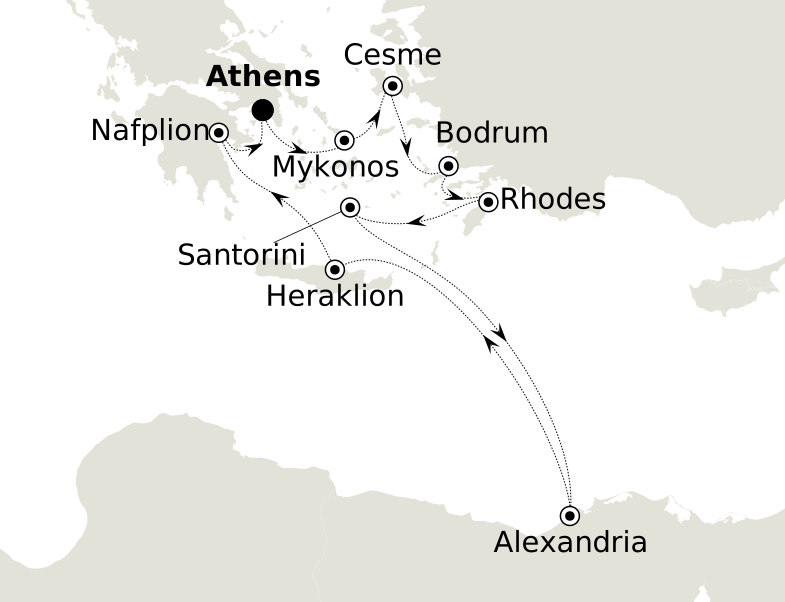
A 11-night ocean voyage aboard Silver Nova, Athens, Greece to Athens, Greece. Destination: Mediterranean.
Operated by Silversea Cruises aboard Silver Nova.
Athens (Piraeus)
Mykonos
Cesme
Patmos
Rhodes
Santorini
Alexandria
Heraklion
Nafplion
A city of legend, civilisation and enduring culture, Athens is a majestic and magical urban sprawl. Extraordinary elegance and grace combine with grit and graft in Greece's capital, where highways encase ruins from antiquity, and gleaming museums and galleries stand beside concrete sprayed with edgy street art. These contrasts enhance and elevate the wonders of this 2,500-year-old city, however, which can count notable contributions to philosophy, drama and democracy, among its global legacy. Piraeus' giant port and naval base welcome you to the edge of the Athens' urban area. From there it's a simple jaunt to the centre. The majestic ancient citadel of the Acropolis dominates an elevated platform and is a constant presence as you explore the city. The wonderful remains of the columned temple of the Parthenon - which date back to the 5th century BC - stand here, representing the pinnacle of classical architecture. The nearby Acropolis Museum adds context to your visit and frames the broad views from its giant glass windows. Or rise up Mount Lycabettus, to be rewarded with perhaps Athens' best panorama of the Acropolis sitting high over the city on its grand stage. See the marble horseshoe of the Old Olympic Stadium, where the first modern Olympics were held in 1896, for more of the city's enduring legacy. Elsewhere, golden beaches and temples stretch out along the coastline, should you wish to explore a little further afield. Coffee is an art form to the Greeks, and it's an unwritten rule that coffee time must never be rushed. So prepare to settle down for a couple of hours and lose yourself in a good chat. Feeling hungry - try traditional souvlaki made with sauces handed from generation to generation.
Indulge in idyllic island life, as you take your fill of superb foods and wines, and soak in endless views of sweeping turquoise seascapes and pretty whitewash buildings. Known for its lively nightlife and rejuvenating, care-free outlook, Mykonos is a dazzlingly beautiful island escape. The secret is well and truly out, but nonetheless, Mykonos has managed to retain the enduring, exclusive allure that first drew celebrities like Brigitte Bardot to its star-studded shores. True to its roots, Mykonos is a rich land of culture, tradition and swirling legend, and the island is said to be built on the frozen bodies of giants slain by Hercules and to have been the legendary battleground between Zeus and the Titans. Head out onto the crystalline waters to seek out serene islands, hit perfect beaches, or venture into the labyrinth of Mykonos Town. White facades, red roofs and cobalt blue shutters add to this lively town’s appeal. Explore narrow streets housing studios – where artisans piece together mosaics - and plenty of restaurants and bars offer sanctuary. Head to Little Venice for a waterfront view of one of the island’s famed sunsets, and to enjoy an aperitif of the favourite aniseed liqueur, ouzo. Boasting numerous attractive sandy coves, a wealth of top-notch restaurants, and rich cultural appeal, it’s little wonder that Mykonos is one of the most popular Greek Islands. Discover this jaw-droppingly scenic island paradise, watched over by its iconic huddles of picturesque windmills.
The seahorse-shaped Patmos is a Greek island of stunning seascapes and immense cultural significance.Whether you’re religious or not there is something of the divine in this gorgeous island - a place of sanctuary fringed by crystal-clear waters and blissful beaches. Sleepy whitewash towns gleam in the strong sunshine while cats slink between the crumbling walls of this ruggedly beautiful island. High on the hillside above the cobalt-blue bay you’ll find the sacred chapel where an exiled John of Patmos is said to have entered the Cave of the Apocalypse and prophesied of the end of the world’s fire and brimstone – a striking juxtaposition with the peaceful serenity of the calm location. Higher up you’ll find the 11th-century Monastery of St. John which offers spectacular views of the island’s mounds curving around like a scorpion’s tail. It stands watching over the island like a fortified crown. Sun-wrinkled black-robed monks climb the streets up to this World Heritage site where bells peel out melodically. Inside vaulted chambers and stunning frescoes tell stories amid the striking religious iconography. Chora’s incredible narrow streets - moulded white - are an enchanting place to lose your bearings spreading below the monastery. Elsewhere blissful beaches stretch out across the coastline or this remote Greek island’s curves can be admired while bobbing offshore in a sailboat.
Colossus of Rhodes: a colossal question mark The sixth of the Seven Wonders of the Ancient World, the Colossus of Rhodes has only been standing for a very short time. Although world-renowned, this gigantic statue is a mystery. If nothing remains of the Colossus today, its origins are documented in historical writings about the siege of Rhodes from 305-304 BC. To force the Rhodians not to support Egypt, Macedonia sent his troops to lay siege to Rhodes. Despite the construction of a 30-metre-high siege tower protected by metal plates and equipped with catapults, Rhodes held the siege for more than a year before Macedonia withdrew. To celebrate their victory and thank the gods for allowing them to resist, the inhabitants of Rhodes decided to build an extraordinary statue in honour of Helios, the Sun and protector of the island. According to the writings, it required between 12 and 13 tonnes of bronze. Some of this was salvaged from the siege tower and the rest was financed by the sale of weapons and armour abandoned by the Macedonians. The construction of the Colossus was entrusted to Charés de Lindos, a sculptor from Rhodes. It took him 12 years to complete. Sixty-five years later, in 225 or 226 BC, after having won the admiration of the world for its appearance and the technique used to build it, an earthquake caused the statue to twist at the knees and to topple to the ground its 33 metres (108ft). Although Ptolemy III of Egypt offered to finance its reconstruction, the Rhodians refused, an oracle having forbidden them to touch the remains of the Colossus. The tonnes of bronze on the ground allowed people to continue to marvel at the statue until 654, when the Umayyad Muslims dismantled his remains, whose "fingers were bigger than most statues", according to Pliny. It would have taken more than 900 camels to carry away all of its remains. Everything else is guesswork. Despite all the wonder that the statue aroused, no records of its appearance or location have come down to us. However, scientists believe that the figure depicted in the popular image with his legs spread out over the entrance to the port of Rhodes is pure invention. Technically, the structure could not have survived. It is more than likely that this marvel of engineering, almost as tall as the Statue of Liberty, had its legs squeezed together. Its location, too, remains a mystery to this day.
Breathlessly romantic, and incredibly scenic, the azure domes and whitewash buildings that cascade down Santorini's slopes are prime honeymoon material - and relentlessly romantic. A true gem of the Cycladic island group, Santorini is startlingly pretty, and its white windmills and dazzling villages are incredibly easy on the eye. Envy-inducing and evocatively beautiful, Santorini's sunsets are legendary, and the island is a highlight of any voyage to the Greek islands. Look out over the endless expanse of blue waves, filling the massive volcanic caldera of Santorini – and absorb one of the most spectacular views in the world. The sheer rock shoulders of the caldera create an immense, natural amphitheatre - so enjoy the show, as you sip a local, volcanic-mineral enhanced white wine, and fall in love all over again. Any meal is well rounded off with the famous wine, Vinsanto. The east side of the island may lack the incredible panoramas, but it's ideal if all you want to do is recline on volcanic-sand beaches - which range in hues from charcoal-black to flame-red. This beautiful island was forged by powerful volcanic activity, and you can learn more about the huge eruption of 1,600 BCE - which wiped out the Minoan city at Akrotiri. The eruption sank the centre of the island, forming the moon-shaped topography we see now. Visit the archaeological site that has revealed and preserved the village, which was lost to time below the pumice and ash. Some whisper that this destroyed town may even be the fabled Atlantis.
Days at sea are the perfect opportunity to relax unwind and catch up with what you’ve been meaning to do. So whether that is going to the gym, visiting the spa, whale watching, catching up on your reading or simply topping up your tan these blue sea days are the perfect balance to busy days spent exploring shore side.
There is a wonderful Italo Calvino story about a city so removed from its own history that it is as if the modern metropolis sits on the site of an unrelated ancient city that just happens to bear the same name. At times Alexandria, which Alexander the Great founded in the 4th century BC, feels like that. Yet the fallen Alexandria of the ancient Greeks, of Ptolemy, Cleopatra, Julius Caesar, and the Romans, and of pagan cults and the Great Library is underfoot, quite literally, as all of modern Alexandria has been built on the ruins of the old, a city that was capital of Egypt from the 3rd century BC until AD 642, when the Arabs first arrived. Overlay a map of the contemporary city with one from antiquity, and you see that many of the streets have remained the same: Shar'a al-Horreya runs along the route of the ancient Canopic Way, and Shar'a Nabi Daniel follows the route of the ancient Street of the Soma. Near their intersection once stood the Mouseion, a Greek philosophic and scientific center that had at its heart the collection of the Great Library. Yet only fleeting glimpses of this ancient city peak through the modern crust. By the early 20th century, Alexandria was a wealthy trading port. The merchants were fantastically rich—cosmopolitan without beingintellectual—and they enjoyed the sort of idle existence that is born of privilege, a privilege not of high birth but rather of colonial rule, which shielded foreigners from Egyptian law. They lived in villas with extravagant gardens, frequented luxurious shops, gossiped over tea in grand cafés, and lounged on the beach in private resorts along the coast. The population was a multicultural mix of Greeks and Arabs, Turks and Armenians, French and Levantines, Jews and Christians, and this spawned a unique atmosphere. It was this city that belonged to Constantine Cavafy, now regarded as the greatest Greek poet of his era. It was this city to which the novelist E.M. Forster, author of A Passage to India, was posted during World War I. And it was this city that gave birth to Lawrence Durrell's Alexandria Quartet, which captivated a generation of American readers when the books were published in the late 1950s. Then quite suddenly everything changed. The intellectuals and merchants fled, driven out of Egypt by the nationalist revolution of the 1950s, the wars with Israel, and the nationalization of their businesses. It's been five decades since most of the foreigners left—some Greeks and Armenians remained. But if you take the city as it is today and not as a faded version of what it once was, you will find that Alex (as it's affectionately known) remains an utterly charming place to visit. The Mediterranean laps at the seawall along the Corniche, and gentle sea breezes cool and refresh even in the dead of summer. Graceful old cafés continue to draw lovers and friends—Egyptians now, rather than foreigners—while the streets remain as lively and intriguing as ever. Alexandria is still a great city, even now, shorn of its many pasts. Sights Alexandria has grown so rapidly in the last 50 years that it now runs along the coastline from the Western Harbor all the way to Montazah, a distance of more than 16 km (10 mi). It is, nonetheless, a great walking city because the historic Downtown occupies a compact area near the Eastern Harbor, while the ancient sights are a short taxi ride away. Dining Alexandria's culinary gift is extraordinary seafood, drawing on the best of the Mediterranean and the Red Sea. The preparation tends to be simple: grilled or fried, perhaps laced with garlic, herbs, or butter, and typically served with tahini (sesame paste) and a couple of salads on the side. The ingredients are so fresh that anything more elaborate would obscure their flavors. Most places display their offerings of fish, shrimp, crab, calamari, and mussels on ice, and you pay by weight or per serving. The price includes preparation and everything else—there are no hidden costs. If you need help choosing, there will always be someone on hand to guide your selection. Because the focus is on fresh seafood, restaurants in Alexandria (especially the good ones) tend to be informal and quite inexpensive for the quality of what they serve. Naturally, many are near the water, some of them appropriately weathered, while others consist of no more than a few tables in an alley. A few places will levy a service charge, but most will not. In all places a tip of 10% is appropriate. Do not expect alcohol to be served in most restaurants. Off-season, Alexandrians eat meals at standard times: 1 to 3 for lunch and 8 to 11 for dinner. But in summer dinner often begins much later. There is nothing more Mediterranean about Alexandria than the pace of dinner in the summer: after an evening siesta, have a shisha (water pipe) around 11, arrive at a waterfront restaurant after midnight, then wrap up the meal with an early morning espresso at an outdoor café nearby. You don't have to eat so late, of course, but you might be surprised how seductive it is. Hotels Hotels in Alexandria are located in two clusters that are roughly 30 minutes apart. Upscale resort hotels are all out along the eastern shoreline in Montazah, close to or even within the manicured khedivial palace gardens—but not convenient to the city or the historic sights. Lower-budget hotels are almost all Downtown, much more convenient but less tranquil. In truth, with the exception of the Salamlek Palace and the Four Seasons, the luxury hotels in Alexandria are drab, generic places not worth what they charge. Fortunately, a couple of mid-range hotels, including the surprisingly elegant Metropole, make attractive alternatives in the city center. Summer is a busy season, when advance reservations are essential. In spring and fall you may find hotels fully booked on weekends (Friday through Sunday), when residents of Cairo head to Alexandria for some downtime. Outside peak summer season, most hotels discount their prices by 30% to 40%. Many hotels quote prices in U.S. dollars or euros, but if you pay with a credit card, your payment will be charged in the equivalent of Egyptian pounds. Nightlife The joke among foreign residents in Alex is that if you want nightlife, go to Cairo. Things aren't quite that dire, but you'll still find that your nocturnal activities lean toward the wholesome rather than the iniquitous. Some top-end hotels have what pass for discos, and the Salamlek has a casino, but the city as a whole is definitely quieter than the capital. Shopping Alexandria isn't a shopping city. There's little to buy here that you can't do better finding in Cairo, where the selection is much greater. If you're looking for chain stores, try Shar'a Suriya in Roushdi, Alexandria's most upscale neighborhood (15 minutes east of Downtown by taxi), or one of the new shopping malls that have opened up in the past few years. Arts/Entertainment The arts scene in Alex lags way behind Cairo, but there are some beacons of interest to explore. Although Alexandria has a couple of annual and biennial festivals, none would warrant a special trip to Alexandria in itself; however, several events are worth attending if you're in town when they're on.
Days at sea are the perfect opportunity to relax unwind and catch up with what you’ve been meaning to do. So whether that is going to the gym, visiting the spa, whale watching, catching up on your reading or simply topping up your tan these blue sea days are the perfect balance to busy days spent exploring shore side.
It may not be the prettiest place in Crete, but Heraklion's patchwork of history, bustling activity and cultural intrigue makes it the perfect change of pace. This is certainly no sleepy island fishing village, and Greece's fifth-largest city is adorned with a rich collection of quality museums, ancient ruins from antiquity, and a lively culture of its own. A refreshing shift-up from the many quaint beach towns and fishing villages you'll encounter in the Greek islands, Heraklion – also known as Iraklio - has great shopping, extraordinary history and is the ideal base for ventures to the archaeological treasures of Crete. Traded by the Arabic, Venetian and Ottoman empires over the years, Heraklion is a multi-layered place with fascinating tales to tell. The city's impressive Venetian fortress, which waits over the gently rolling waves of the gleaming Mediterranean, welcomes you ashore. A stroll out along the seawall, alongside creaking fishing boats, will take you out to the squat fortifications that have stood since 1540. Climb to the top for views out across the water, back towards the city's waterfront. The sun-roasted earth outside the city hides treasures from the realms of history, including the Bronze Age remnants of Europe's oldest city, Knossos. A visit to the fantastic Archaeological Museum of Heraklion ties all of this history together and exhibits relics from the civilisations and eras of Crete's past. Elsewhere, Daidalou's pedestrianised paving is a charming stroll through Heraklion's shops, with streets branching off to café-lined plazas and twinkling fountains. Stop to try local food - like fresh feta and olive sprinkled dakos mezze – all washed down with a sample of local raki brandy.
Greece’s first capital remains the escape of choice for Athenians, who weekend here to indulge in the town's gorgeous seaside setting. One of the country's most romantic towns, the warm colour palette and tempting, island-sprinkled waters, pull on plenty of heartstrings. With perfect beaches, crystal clear waters for swimming, and evocative fortress-capped mountains, Nafplion is a sun-soaked Greek beauty. A gorgeous blend of Greek, Byzantine, Venetian and Ottoman influences, stroll the seafront promenade and soak up the ambience in tavernas and bars. Head into the warren of an old town, which is full of narrow streets, neoclassical architecture and pink-flowered trees drooping over walls. Located on the hill that towers over Nafplion, Palamidi Fortress is a Venetian castle built in 1714, and its steep walls flow dramatically down the slope. If you're feeling brave, a slog of 857 steps will take you to the top to see beautiful views across Nafplion and the Argolic Gulf. Acronafplia fortress is Nafplion's oldest castle, and its walls enclosed the entire town until the 13th century. Just offshore, the Venetian Bourtzi fortress rises on a tiny islet, a short boat ride away across the glistening waters. Venetians built this harbour fortress to protect the town before it later housed the official executioner. Today its hardy walls shake to music, during its summer festival, and the castle enjoys a gorgeous view back over the waves to the town's humming waterfront. Ancient cities like Corinth lie close by, recovered and unearthed after being wiped from history by immense earthquakes.
A city of legend, civilisation and enduring culture, Athens is a majestic and magical urban sprawl. Extraordinary elegance and grace combine with grit and graft in Greece's capital, where highways encase ruins from antiquity, and gleaming museums and galleries stand beside concrete sprayed with edgy street art. These contrasts enhance and elevate the wonders of this 2,500-year-old city, however, which can count notable contributions to philosophy, drama and democracy, among its global legacy. Piraeus' giant port and naval base welcome you to the edge of the Athens' urban area. From there it's a simple jaunt to the centre. The majestic ancient citadel of the Acropolis dominates an elevated platform and is a constant presence as you explore the city. The wonderful remains of the columned temple of the Parthenon - which date back to the 5th century BC - stand here, representing the pinnacle of classical architecture. The nearby Acropolis Museum adds context to your visit and frames the broad views from its giant glass windows. Or rise up Mount Lycabettus, to be rewarded with perhaps Athens' best panorama of the Acropolis sitting high over the city on its grand stage. See the marble horseshoe of the Old Olympic Stadium, where the first modern Olympics were held in 1896, for more of the city's enduring legacy. Elsewhere, golden beaches and temples stretch out along the coastline, should you wish to explore a little further afield. Coffee is an art form to the Greeks, and it's an unwritten rule that coffee time must never be rushed. So prepare to settle down for a couple of hours and lose yourself in a good chat. Feeling hungry - try traditional souvlaki made with sauces handed from generation to generation.
From $10,450
per guest · 11 nights
Prices are a guide and vary with season, cabin category and party size. Your advisor will confirm the exact cost before anything is booked.
Classic Veranda
suite
Deluxe Veranda
suite
Grand 1 Bedroom
suite
Junior Grand 1 Bedroom
suite
Junior Grand 2 Bedroom
suite
Master
suite
Medallion
suite
Otium
suite
Owner 1 Bedroom
suite
Owner 2 Bedroom
suite
Premium Medallion
suite
Premium Veranda
suite
Signature
suite
Silver
suite
Superior Veranda
suite








